Robinhood’s Crypto Fees
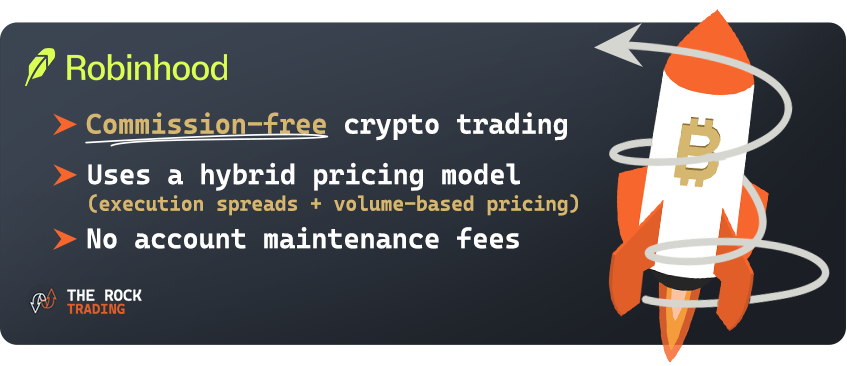
Robinhood has two account types which are Cash and Margin, and while they offer commission free trading, the costs are embedded in the pricing as a dynamic spread applied at the time of the transaction. While Cash is the standard retail investor account, you can open up to 10 individual brokerage accounts, but there’s no support for custodial accounts, trusts, or business accounts.
As for other account types, you can also open individual retirement accounts (IRA), and you get a 1% match for IRA contributions which is great if you’re looking for a broker that can accelerate your retirement savings, or a 3% match if you’re a Robinhood Gold member. The gold membership costs $5 per month for this premium service which has a lot of benefits for crypto investors.
Robinhood Trading Fees Explained
Robinhood’s fee structure isn’t purely a spread model, but it combines competitive volume-based pricing with execution spreads. This hybrid model is suitable for maintaining their low-cost Robinhood reputation, but this may lead to worse execution compared to other brokers.
Instead of maker/taker fees on orders, the firm routes them to external third-party liquidity providers. While this has predictable costs, it lacks rebate opportunities you get on other investing platforms with public limit-order books.
However, there are different crypto order routing models on Robinhood. If you use the app, you can choose for your orders to be routed to partner exchanges which are liquidity providers, or via market makers which are non-liquidity providers.
| Smart exchange routing | Market maker routing |
|---|
| Trading venue routed to | Exchanges | Market makers |
| Rebate Robinhood Crypto receives from trading venues | 0.00% | 0.85% |
| Fees | 0.10%-0.85% | No fees |
| Mobile app | Available for certain crypto assets | Available for all crypto assets |
| Desktop app (Robinhood Legend) | The only routing setting, available for certain tradable crypto | Unavailable |
| Web browser (Classic mode) | Unavailable | The only routing setting, available for certain tradable crypto |
If you trade via their web-based platform, Robinhood Legend, they’ll route your orders through smart exchange routing, while their web classic button can switch it to market maker routing.
Spread and Pricing Transparency
For each trade you make, the spread is simply added to the quoted price, and though the spread is small, it still fluctuates based on market volatility and liquidity. The platform’s bid/ask spread reportedly ranges from 0.03% to 0.85%, and Robinhood generates significant revenue through payment for order flow, and this is why it affects order execution quality so much.
You’ll notice that the cost of a bought crypto asset is almost always slightly higher than the mid-market rate while the selling price is slightly lower. The spreads may especially widen during uncertain market climates, but it may also depend on the crypto asset’s liquidity.
Since the cost of the asset is baked into the price, it’s harder for traders to measure their exact cost per trade on Robinhood compared to other brokers’ fee structures which are arguably more transparent.
Other Fees to Be Aware Of
Robinhood is better suited if you are a casual trader because there’s no hidden charges like inactivity fees or account fees like on Gemini or eToro, plus there’s no minimum deposit or cost to trade. You’re free to keep your account open to trade whenever you feel like it without expecting any monthly costs, though your standard blockchain network fees still apply to crypto withdrawals.
As for other fees on Robinhood, there are no platform fees, no subscription charges for crypto, and no deposit fees. But, if you ever want to transfer your entire account to another broker, Robinhood charges a $100 ACAT fee.
Robinhood earns a high score for eliminating inactivity, account, and commission fees, which is ideal for casual traders. However, the score is negatively impacted by the lack of pricing transparency and the use of payment for order flow that seriously impacts execution quality. The hybrid spread model remains less predictable than the fixed maker/taker structures found on specialized exchanges. This has been proven to be historically problematic for many investors which is why we give them a score of 4/10.
Crypto Markets
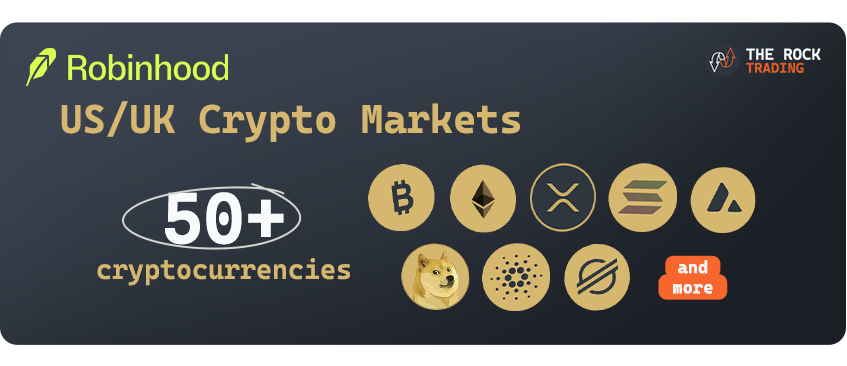
Robinhood offers a narrow, but very popular crypto list, supporting over 50 cryptocurrencies for the US market, and over 70 cryptocurrencies for Europe. There’s more on the EU platform than the US because of differing regulatory frameworks like MiCA which has a faster listing process on niche tokens. You can invest in ETFs, options, fractional share trading, but there are no bonds, forex, or mutual funds.
Robinhood's Available Cryptocurrency Markets
This table shows which cryptocurrencies are available on Robinhood by region. The UK and US platforms offer a similar spot only digital coin list under different regulations, while the EU platform provides access to a broader range of tokens.| Cryptocurrency (Name & Symbol) | Europe | USA & UK |
|---|
| Bitcoin (BTC) | ✓ | ✓ |
| Ethereum (ETH) | ✓ | ✓ |
| XRP (XRP) | ✓ | ✓ |
| Solana (SOL) | ✓ | ✓ |
| Cardano (ADA) | ✓ | ✓ |
| Avalanche (AVAX) | ✓ | ✓ |
| Dogecoin (DOGE) | ✓ | ✓ |
| BNB (BNB) | ✓ | ✗ |
| Toncoin (TON) | ✓ | ✗ |
| Polkadot (DOT) | ✓ | ✗ |
| Chainlink (LINK) | ✓ | ✓ |
| Litecoin (LTC) | ✓ | ✓ |
| Stellar Lumens (XLM) | ✓ | ✓ |
| Shiba Inu (SHIB) | ✓ | ✓ |
| USDC (USDC) | ✓ | ✗ |
| Uniswap (UNI) | ✓ | ✗ |
| Polygon (POL) | ✓ | ✗ |
| Arbitrum (ARB) | ✓ | ✗ |
| Cosmos (ATOM) | ✓ | ✗ |
| Optimism (OP) | ✓ | ✗ |
| Aave (AAVE) | ✓ | ✓ |
| Bitcoin Cash (BCH) | ✓ | ✗ |
| Hedera (HBAR) | ✓ | ✗ |
| Near (NEAR) | ✓ | ✗ |
| Render (RENDER) | ✓ | ✗ |
| Immutable (IMX) | ✓ | ✗ |
| Ethereum Classic (ETC) | ✓ | ✗ |
| The Graph (GRT) | ✓ | ✗ |
| Quant (QNT) | ✓ | ✗ |
| Algorand (ALGO) | ✓ | ✗ |
| Tezos (XTZ) | ✓ | ✗ |
| Curve DAO (CRV) | ✓ | ✗ |
| Compound (COMP) | ✓ | ✗ |
| Lido DAO (LDO) | ✓ | ✗ |
| Decentraland (MANA) | ✓ | ✗ |
| Sandbox (SAND) | ✓ | ✗ |
| ApeCoin (APE) | ✓ | ✗ |
| Celestia (TIA) | ✓ | ✗ |
| Sei (SEI) | ✓ | ✗ |
| Sui (SUI) | ✓ | ✗ |
| Starknet (STRK) | ✓ | ✗ |
| LayerZero (ZRO) | ✓ | ✗ |
| zkSync (ZK) | ✓ | ✗ |
| Wormhole (W) | ✓ | ✗ |
| Jupiter (JUP) | ✓ | ✗ |
| Ondo (ONDO) | ✓ | ✗ |
| Mantle (MNT) | ✓ | ✗ |
| Ethena (ENA) | ✓ | ✗ |
| Hyperliquid (HYPE) | ✓ | ✗ |
| Bonk (BONK) | ✓ | ✓ |
| Pepe (PEPE) | ✓ | ✓ |
| Dogwifhat (WIF) | ✓ | ✓ |
| Floki (FLOKI) | ✓ | ✗ |
| Popcat (POPCAT) | ✓ | ✗ |
| Pudgy Penguins (PENGU) | ✓ | ✗ |
| cat in a dogs world (MEW) | ✓ | ✗ |
| Peanut the Squirrel (PNUT) | ✓ | ✗ |
| Moo Deng (MOODENG) | ✓ | ✗ |
| Aerodrome Finance (AERO) | ✓ | ✗ |
| Maple Finance (SYRUP) | ✓ | ✗ |
| Onyxcoin (XCN) | ✓ | ✗ |
| OFFICIAL TRUMP (TRUMP) | ✓ | ✗ |
| Plasma (XPL) | ✓ | ✗ |
| Virtuals protocol (VIRTUAL) | ✓ | ✗ |
| World Liberty Financial (WLFI) | ✓ | ✗ |
| Zora (ZORA) | ✓ | ✗ |
| EURC (EURC) | ✓ | ✗ |
| Aster (ASTER) | ✓ | ✗ |
| Avantis (AVNT) | ✓ | ✗ |
| Berachain (BERA) | ✓ | ✗ |
| Lighter (LIT) | ✓ | ✗ |
| Sky (SKY) | ✓ | ✗ |
| Sonic (S) | ✓ | ✗ |
Leverage for crypto is only available for the EU market via Perpetual Futures on Robinhood and it goes up to 7x on major assets like BTC and ETH.
Available Cryptocurrencies
While the list of cryptocurrencies Robinhood offers is much smaller than on other exchanges, they prioritize high-volume coins like Bitcoin (BTC), Ethereum (ETH), Dogecoin (DOGE), Solana (SOL), and others that offer decent liquidity for traders who prefer stable trades.
However, there are no experimental tokens or early-stage projects, so if you’re looking to profit off of newcoming crypto assets, it’s better to check out UniSwap, ByBit or other platforms.
Fiat-to-Crypto Markets
The firm has a USD-centric funding model for most users that’s restricted to US dollar funding because of regulatory compliance, but most importantly it removes any complicated foreign exchange overhead which synchronizes traders’ buying power, and effortless purchase of digital assets.
Because of this, there’s also no multi-fiat investing, so European users are only restricted to EUR, while US-based citizens can only use dollars.
Robinhood also has a intentionally simplified fiat on-ramp design that functions like a digital wallet, and it lets you convert cash into crypto with a simple swipe which also removes the need for complex deposit codes or manually copying wallet addresses.
Trading Pairs and Liquidity
On Robinhood, there are no visible trading pairs or order book because they manage liquidity internally and through their centralized, asset-to-fiat aggregation model which trades go directly against your local currency. Robinhood prioritizes execution speed and simplicity over the transparency of a visible “tape” or market depth, but you can still expect robust liquidity for major assets.
The third-party liquidity providers manage the execution quality and provide constant pricing data daily. Since Robinhood doesn’t host its own internal order book, you’ll have wider spreads during volatile market periods or weekend trading.
However, Robinhood has a feature called “Price Improvement” which captures better execution rates for you by routing the order to the venues offering the best competitive bid or ask price, precisely in milliseconds.
The firm scores impressively for its regional adaptability, but nothing can excuse the fact that this is one of the few brokers with the lowest number of crypto coins, second only to PrimeXBT which have 7 crypto assets. Combined with the questionable transparent order book quality with wider spreads, and no mutual funds, forex, or bond trading, we give Robinhood a score of 3/10 in the market listing department.
Trading Platforms and Tools
Robinhood prioritizes simplicity over functionality which is evident by their single platform available as a web browser or mobile app, but their platform has improved with the 2024 launch of their flagship Robinhood Legend which is a web-based app designed for active traders with advanced features.
The web and mobile app features include:
- Simple candlestick charts and research tools
- Real-time pricing with simple order types (market and limit only)
- Price alerts and holdings overview
- No depth of market (DoM), or volume tools
- No support for third-party platforms, APIs, or automation
The apps are straightforward and neatly designed for ease of use, but without a lot of advanced tools compared to Robinhood Legend. Charting and order types are severely limited, and the indicators are simplified compared to other exchanges and platforms.
Additionally, Robinhood Gold members have exclusive access to tools such as Level II market data and analytics research tools, but this is only allowed for stocks which is a disappointment, and there’s no integration with TradingView or cTrader, either.
Robinhood Web Platform
At a glance, Robinhood’s web platform has a very clean, beginner-friendly interface with basic candlestick charts with adjustable timeframes, and the interface allows for your run-of-the-mill basic order placement.
The expanded desktop view is the standard for technical clarity and overview, but in the meantime, there’s also Robinhood’s financial news platform called Sherwood News if you need another source for the latest crypto news. For the charting tools, you have simple candlesticks, and technical indicators like RSI, MACD, and moving averages for deep analysis and market trend recognition.
The web platform also has ‘Cortex Digests’ which is a tool that’s exclusive to Robinhood Gold members who want AI-powered market analysis and insights into specific crypto assets in real time.
Mobile App Experience
Robinhood’s mobile-first approach is obvious, making it an easy choice for investors who prefer to trade from their phone. Their mobile app allows you to execute simple trades, set custom price alerts, and real-time monitoring. The interface and buttons feel just right for all finger sizes, but the design feels like it encourages overtrading due to its fast and visually engaging interface.
Though there are plans for 2026 to update the platform to integrate Robinhood Legend to the mobile app, the controls as of now still feel limiting for active traders. Additionally, Robinhood also announced the release of Robinhood Social which will be a feature on the mobile app which aims to create a community for traders who are looking to connect and share strategies.
Robinhood Legend
Robinhood introduced their flagship Robinhood Legend which is the go-to for advanced tools, as a dedicated desktop experience that offers millisecond precision data and customizable layouts to suit your specific trading style.
Legend offers a fully-customizable, multi-window desktop environment with better overview, and lots of tools for advanced traders with over 80 technical indicators. You can link multiple widgets and synchronize charts across monitors with high-speed data refreshes.
There’s also a highly useful ‘ladder’ widget that allows rapid-fire execution and a scanner tool on Robinhood Cortex that lets you filter crypto assets for matching technical criteria which can be excellent for precision trading.
Robinhood Strategies
Robinhood has a robo-advisory service called Robinhood Strategies that builds portfolios based on clients’ preferences, and it’s available on all platforms, but exclusively for Gold subscribers.
While it’s not a platform, it’s a more of a personalized service with enhanced control that manages your portfolios featuring a blend of ETFs and individual stocks, tax-loss harvesting, automated investing, and can align with your risk tolerance and financial goals for a low 0.25% annual management fee. There’s also fee-free management for assets over $100,000 for Gold subscribers.
Robinhood’s web and mobile apps have a very intuitive design which is perfect for beginner investors. But, there’s a serious lack of advanced trading and analytics tools which forces investors to subscribe to a Gold membership just to use essential research tools. The app’s design has faced criticism for potentially encouraging frequent and risky trading behavior among new investors, and this is a serious reason why we give the platforms a score of 4/10.
Safety and Regulation
Robinhood is a registered broker-dealer regulated by the SEC (Securities and Exchange Commission) and a member of FINRA (Financial Industry Regulatory Authority) for securities, ensuring it follows strict regulatory standards for protecting client funds, and it also has FinCEN and MiCA-compliant crypto licenses.
Though Robinhood is a US-based company, your digital crypto assets are handled under a different set of rules, as Robinhood Crypto LLC operates as a separate legal entity from the main brokerage. European users invest on Robinhood via Robinhood Europe, UAB, which is regulated by the Bank of Lithuania as a financial brokerage and crypto asset provider, also operating under MiCA.
Regulation and Licences
Robinhood also has SIPC (Securities Investor Protection Corporation) protection which covers up to $500,000 of the investors’ stocks if the brokerage firm ever fails and goes bankrupt, while the FDIC (Federal Deposit Insurance Corporation) protection covers your cash held in Robinhood’s spending or bank accounts up to $250,000.
While SIPC and FDIC protect your stocks and cash, your cryptocurrency is protected by Robinhood’s internal security protocols and private insurance policies rather than the federal government-backed protocols.
Custody and Asset Storage
To protect your holdings, the platform has a cold storage system that keeps the users’ assets offline and completely disconnected from the internet. This custodial model significantly reduces the risk of loss through large-scale exchange hacks or technical breaches, and the assets are also protected by a crime insurance policy underwritten by Lloyd’s syndicates.
What’s interesting is that Robinhood has a custodial model where they manage your private blockchain keys, and this also solves the problem of you ever losing access to your available assets in case you forget the seed phase. This is obviously a safety net targeted at new investors.
You can also transfer your assets at any time to your non-custodial Robinhood wallet for your 100% ownership.
Account Security Features
Robinhood has standard security protocol features like most brokers, and your account is secure through mandatory two-factor authentication (2FA), device approval and account alerts, biometric verification via Touch/Face ID, SMS codes, and also third-party authenticators like Google Authenticator. They have supplemental protection that covers up to $50 million in securities and $1.9 million in uninvested cash.
However, there are no risk controls aside from the wallet, and there are no client negative balance protection for brokerage accounts which might be a major downside.
Since 2021, Robinhood hasn’t suffered any major data breaches, or security incidents affecting crypto accounts, and their core infrastructure is considered safe and secure.
We give Robinhood a score of 8/10 in safety for its crypto operations by having them regulated through legal entities like Robinhood Crypto, LLC and the MiCA-compliant Robinhood Europe. While it provides industry-leading cold storage and private crime insurance through Lloyd’s syndicates, the score is slightly lowered because there is no native negative balance protection which is found in many crypto brokers.
Funding and Withdrawals
Your account can be funded through ACH bank transfers, instant debit card deposits, and direct crypto transfers, with a minimum order requirement as low as $0.01 for most assets.
Your cryptocurrency funding is tied directly to Robinhood’s fiat account system which allows you to instantly use funds from stock sales or bank deposits to purchase digital assets, so you won’t need a separate crypto-only wallet for funding.
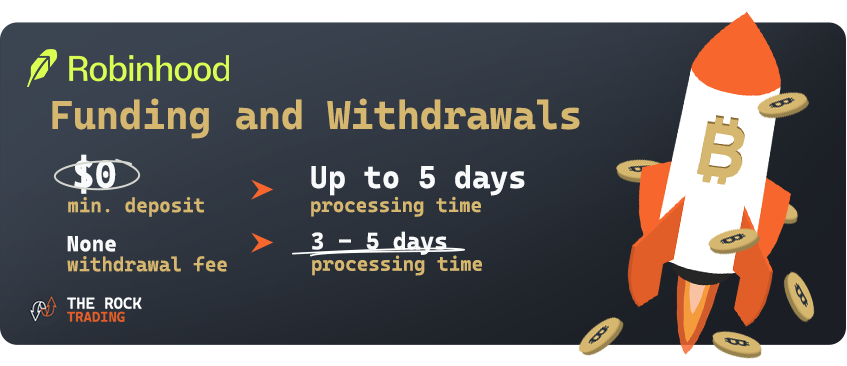
Both deposits and withdrawals are free via ACH, and you can choose between free standard ACH withdrawals, instant transfers to a bank or card with a 1.75% fee, or transferring crypto coins to an external private wallet.
Deposit Methods
You can fund your account via ACH bank transfers which offer no minimum deposit with the process taking up to five business days, and for Robinhood Gold members, the highest deposit is $50,000. You can also use card transfers for rapid funding, with the process taking around 30 minutes at the time of the transaction.
You can use direct deposit to allocate a specific portion of your profit and transfer them into your spending or investing account, and you can also use your Robinhood Connect feature to transfer the assets to external wallets.
Instant access to deposits are limited to $1,000 for standard accounts, and $5,000 for Gold members. The minimum order size still stands with $0.01 for Market Maker routing, and $0.03 for Smart Exchange, on all deposit/withdrawal methods via ACH, Debit, Crypto, or via Connect.
Withdrawal Methods and Times
Withdrawing your funds is available via standard ACH transfers, and though they’re free of charge, they typically take 3-5 business days to reach your account with a withdrawal limit of $50,000 for standard accounts.
Though, if you want a quicker way to your profits, you can use the Instant Withdraw feature for transfers to a linked debit card or bank account for a 1.75% fee, with a maximum charge of $150, but this method lets you withdraw up to $5,000 a day.
Withdrawal Fees and Network Costs
Robinhood offers straightforward crypto withdrawal with minimal blockchain network fees and address fees, and there are no platform withdrawal fees. The platform doesn’t charge you an internal service fee to send your assets to an external wallet.
You can send supported cryptocurrencies to external wallets as well, and these blockchain transfers are processed within 10 to 30 minutes with standard network gas fees. However, there have been complaints regarding network congestion that can significantly slow down the transferring period up to several hours. Some coins may not be eligible for withdrawal, and advanced crypto trading features like staking are only available on crypto assets like Ethereum and Solana.
Robinhood scores a 7/10 for its seamless integration between fiat and crypto funding that lets you instantly deploy stock sale proceeds into digital assets. However, it loses points for its relatively low $50,000 daily withdrawal cap and the 1.75% fee on instant transfers, which is significantly higher than the low flat fees found on professional exchanges like Binance or KuCoin.
Trading Rules and Limitations
You can make unlimited buy and sell transactions on digital crypto assets regardless of your account balance or account status which makes it perfectly low-risk for most new investors.
The firm supports a non-restrictive trading style that permits HFT (high frequency trading) strategies like scalping, as long as they are executed manually or through the official Robinhood API.
- Scalping: Fully allowed. If you’re a day trader, you could benefit from using the “Ladder” widget on Robinhood Legend specifically for this strategy.
- Automated Trading: Supported through the Robinhood Crypto API, which now includes tiered fee support for high-volume bots.
- Hedging: Restricted. You cannot maintain offsetting positions on the same asset within one account.
- Copy Trading: Not a native feature, though you’re free to manage your own trades or use third-party integrations at will.
- Stop-Out Rules: For leveraged European accounts, positions are automatically liquidated if your maintenance margin falls below the required threshold.
- Margin: In the U.S., you must use 100% settled cash; there is no “margin” allowed for crypto, preventing debt-based liquidations.
You’re free to enter and exit positions many times a day without triggering account restrictions, but strategies like hedging are forbidden on the platform.
Minimum Trade Sizes
 Arguably one of the best features of Robinhood is that it allows you to invest by purchasing cryptocurrency with as little as $1 for most crypto assets which makes sense for fractional crypto or fractional share trading.
This is one of the main reasons why Robinhood is a solid hub for small balances and low-risk casual investing with low minimums. It’s a great platform if you want to gradually increase your positions and get yourself comfortable during volatile market conditions.
Geographic Restrictions
 While Robinhood Crypto is US-focused and operates primarily within the United States, it has expanded in 2026 to include the United Kingdom and over 30 countries across the European Union and EEA.
Access to features like Cortex Digests or Robinhood Legend apps is currently rolling out and some are expected to be fully implemented near mid-2026.
Robinhood Crypto Product Availability by Region
This table shows which crypto products and features are available on Robinhood across the US, EU/EEA, and UK, highlighting where access and functionality differ by regulation.| Crypto Product / Feature | United States | European Union / EEA | United Kingdom |
|---|
| Spot crypto trading | ✓ | ✓ | ✓ |
| Real crypto ownership | ✓ | ✓ | ✓ |
| Crypto custody (custodial) | ✓ | ✓ | ✓ |
| Transfers to external wallets | ✓ | ✓ | ✓ |
| Crypto-to-crypto pairs | ✗ | ✗ | ✗ |
| Public order book | ✗ | ✗ | ✗ |
| Commission-free pricing (spread based) | ✓ | ✓ | ✓ |
| Crypto leverage | ✗ | ✓ (via perpetual futures) | ✗ |
| Crypto perpetual futures | ✗ | ✓ | ✗ |
| Margin trading (crypto) | ✗ | ✓ (derivatives only) | ✗ |
| Advanced derivatives (options, structured products) | ✗ | ✗ | ✗ |
Leverage and Margin Availability
Robinhood does not offer leverage for crypto, and there is no margin trading for US-based traders. US traders cannot use their stock portfolio to borrow funds for crypto purchases because crypto investing on the platform is non-marginable and only applies to stocks.
 All trading is done in USD pairs. You can’t trade crypto-to-crypto, and there are no perpetual contracts or structured products.
While they expanded their listings to include futures trading, only European traders can access Perpetual Futures with up to 7x leverage on major assets like BTC and ETH.
Robinhood earns a score of 6/10 in this category for effectively eliminating the Pattern Day Trader (PDT) barrier for crypto, and its overall score is slightly held back by the lack of native hedging and copy-trading features, which are common on more specialized exchanges.
Is Robinhood Good for Crypto in 2026?
Robinhood is arguably excellent for beginner traders and casual investors looking for a very straightforward and least-resistance platform that just does the job for most casual trading styles. Though restrictive by design, Robinhood deliberately aims to greatly reduce complexity for new traders, not to mention the highly secure custodial model and commission-free trading.
However, the limited coin selection and advanced trading options, limiting platform integration and lack of leverage or technical tools, makes Robinhood unsuitable for active or technical traders looking to run more advanced strategies. A major downside is that Robinhood has questionable pricing transparency due to hidden execution costs instead of flat fees. This lack of a visible order book makes it difficult for anyone to verify if they’re getting the most competitive market price.
Compared to Coinbase or Binance, Robinhood’s listings are extremely minimal, and the two brokers also offer advanced staking and a chance to encounter new projects with direct crypto-to-crypto pairs, whereas Robinhood lacks this. The broker simply gives me the impression that they lost more than they gained by prioritizing major coins and sacrificing advanced on-chain features.