Pepperstone Crypto Fees
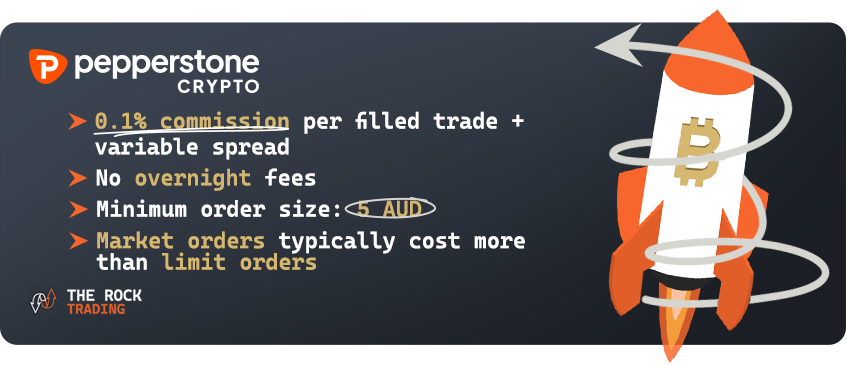
With Pepperstone Crypto, costs are mostly commission + spread. You pay a flat 0.1% commission on every filled trade, and you pay the bid/ask spread, which changes with liquidity and volatility. Because it’s spot trading, there are no overnight funding/swaps like you’d see on crypto CFDs.
There’s a few minimums that affect how you place orders and your trade sizes.
- Minimum price movement: 0.1 AUD
- Minimum trade amount: 0.00001 BTC (pair-dependent)
- Minimum order size: 5 AUD
The platform uses a maker/taker model (maker adds liquidity, taker removes it). In real terms, your order type is what matters: market orders usually cost more overall because you cross the spread immediately, while limit orders give you price control and can reduce the all-in cost when the spread looks wide.
Outside of trading, there’s no extra platform fee just for submitting or cancelling an unfilled order.
Crypto Markets
Pepperstone Crypto is a spot crypto exchange and, right now, it’s a small, AUD-based market lineup. You can trade 5 cryptocurrencies and you’re trading them as spot (no CFDs, no futures, no perps on the exchange).
Pepperstone Crypto Markets
| Crypto / Fiat Pair | Symbol |
|---|
| Bitcoin / Australian Dollar | BTC/AUD |
| Ethereum / Australian Dollar | ETH/AUD |
| Solana / Australian Dollar | SOL/AUD |
| Tether / Australian Dollar | USDT/AUD |
| USD Coin / Australian Dollar | USDC/AUD |
The table below lists every spot trading pair currently available on Pepperstone Crypto, shown as the full asset names against Australian Dollar (AUD), alongside the pair symbol you’ll see on the platform.This is a quality over quantity setup to launch with. It suits you if you mainly trade majors or use stablecoins, but it won’t suit you if you’re chasing new listings, meme coins, or a big altcoin menu, you’ll need an exchange like Binance or Coinbase.
Pepperstone Crypto vs Australian Exchanges
| Feature | Pepperstone Crypto | CoinSpot | Swyftx | Independent Reserve |
|---|
| Available Assets | 5 | 400+ | 320+ | 30+ |
| Trading Fee | 0.1% commission | 0.1% (OTC) / 1% (market) | 0.6% | 0.5% maker / 0.5% taker |
| AUD Deposits | Bank transfer | Bank transfer, PayID, card | Bank transfer, PayID | Bank transfer |
| Spot Trading | Yes | Yes | Yes | Yes |
| Mobile App | Yes | Yes | Yes | Yes |
| AUSTRAC Registered | Yes | Yes | Yes | Yes |
| Best For | Major coins, simple AUD setup | Altcoin variety | Beginners, wide asset range | Bitcoin-focused traders |

Fiat-to-Crypto Markets
Everything is built around AUD pricing, so you’re not dealing with a long list of fiat currencies. In practice, that means your main path is AUD → coin (or coin → AUD), and the stablecoins are also available against AUD, which is useful if you want to park value in USDT/USDC without leaving the platform.
Trading Pairs and Liquidity
Because there are only a handful of pairs, liquidity is concentrated. That’s generally a good thing for execution on the main markets, but it also means you need to be a bit more deliberate with order choice:
- For BTC/AUD and ETH/AUD, you’ll usually see the most activity and the tightest conditions.
- For stablecoin pairs and SOL/AUD, liquidity can still be fine, but it’s worth checking the order book before using market orders.
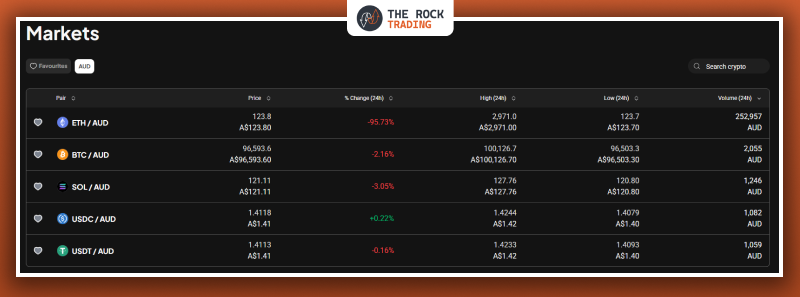
The crypto exchange makes this easy because you can see the live order book, recent trades, and a depth chart on the same screen. If the book looks thin at the top levels, use a limit order to control entry price and reduce slippage, especially if you’re trading larger size.
Visit Pepperstone
Trading Platforms and Tools
Pepperstone Crypto uses a TradingView-style interface across its web trader, and it’s also available via tablet and mobile app. The layout is familiar if you’ve used mainstream spot exchanges, and I found it to be a very simple set up on both web and mobile.
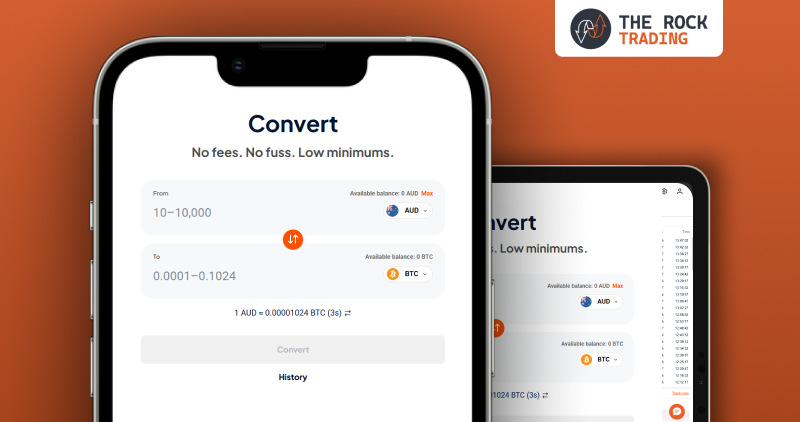
If you just want a quick swap without thinking about the order book, there’s also a Convert feature. That’s aimed at simple conversions (crypto-to-crypto or crypto-to-fiat where available) and is usually the fastest route for small, straightforward trades.
On the trading screen itself, you get the core tools most retail traders actually need. Order placement supports market, limit, and stop orders (including stop behaviour that can be used as stop-market or stop-limit depending on how you set it).
Charting is TradingView technical indicators and drawing tools, plus a depth chart view that helps you judge liquidity around the current price.
Both web and apps also have an order book (bids/asks with size) and the trade tape (recent fills with time, price, and amount), which is useful for spotting thin books and fast-moving price action.
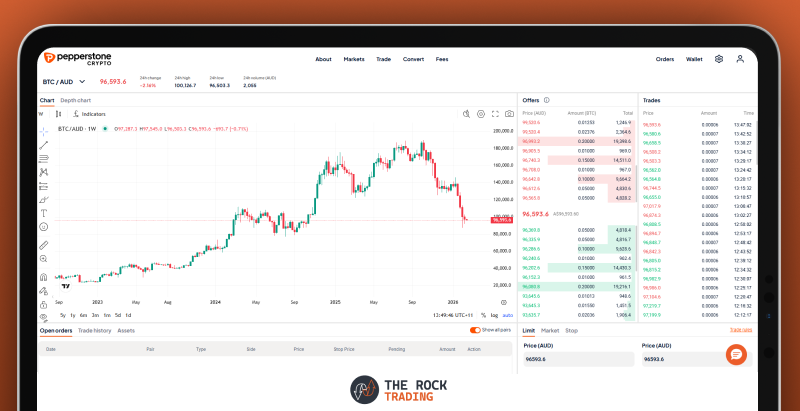
You can then track and manage positions through the Orders area and monitor holdings in Wallet, which keeps the basic workflow clean – analyse, place, manage, withdraw.
Safety and Regulation
Pepperstone Crypto is a separate Australian crypto exchange entity under Pepperstone Digital Pty Ltd, so it’s not the same service as Pepperstone’s CFD broker. The Pepperstone name is well-known and respected globally in online trading, which makes it more credible than a new, unknown crypto exchange, but your protections and risks here come from the exchange’s own setup (AUSTRAC status, custody model, account security), not the brokerage’s CFD trading framework.
Regulation and Licences
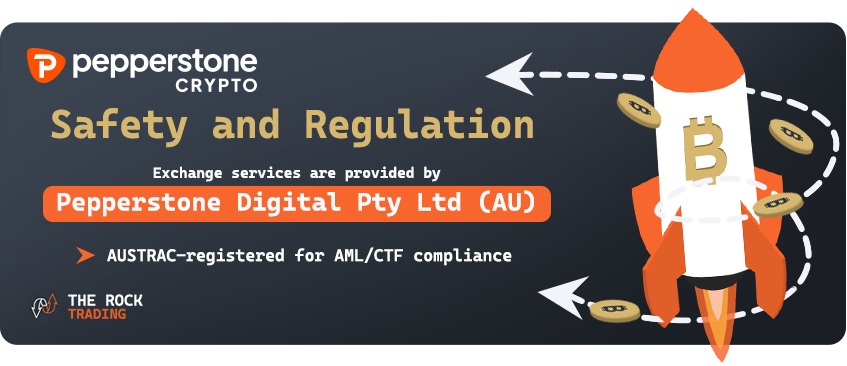
Pepperstone Crypto’s exchange services are provided in Australia by Pepperstone Digital Pty Ltd, and it’s AUSTRAC-registered for digital asset services. In practice, that’s an AML/CTF registration, so it’s mainly about identity checks, transaction monitoring, and reporting standards, rather than a “financial products” licence. Which is how all crypto exchanges in Australia operate as ASIC is currently in the process of developing a crypto licensing regime.
They also disclose two things you should understand before you fund the account:
- No AFSL for this exchange product. So it’s not operating under the same licensing framework you might associate with Pepperstone’s forex/CFD business.
- Trading is done with Pepperstone Crypto as your counterparty, providing direct settlement certainty rather than being matched directly with another user on a pure order book.
So you’re dealing with an Australian exchange entity fully registered with AUSTRAC obligations met (good trust signal). The regulatory framework differs from AFSL-regulated CFD products, which is standard across all Australian crypto exchanges.
Custody and Asset Storage
Pepperstone Crypto uses a custodial wallet model. When you buy crypto on the exchange, your balance sits in your Pepperstone Wallet unless you withdraw it to an external wallet you control.
On storage, they describe a typical centralised exchange setup:
- Most assets are held in cold storage, to reduce online exposure.
- A smaller portion is kept in hot wallets to support trading and withdrawals.
This matters because custody is the main risk lever on any exchange. If you’re actively trading, leaving funds in your Pepperstone Crypto account is normal. If you’re holding long term, the risk profile changes and you may prefer withdrawing to a self-custody wallet once you’re done trading.
Account Security Features
Pepperstone Crypto supports the main controls you’d expect for retail account protection, and they’re worth using even if you’re “only” testing the platform with small amounts.
- 2FA via an authenticator app (Google Authenticator): This is the baseline for reducing account takeover risk.
- Withdrawal address controls (whitelisting): If you lock withdrawals to approved addresses, it becomes much harder for an attacker to send funds to their own wallet even if they get into your account.
- Step-up checks for sensitive actions: Their flows reference extra verification steps for actions like withdrawals (for example, email one-time codes alongside authenticator verification).
If you’re coming from Pepperstone’s crypto CFD trading side, it’s worth resetting expectations and not merge the two entities – this is spot crypto, not a broker account. You’re not relying on broker-style protections here like negative balance protection (but aren’t trading with leverage and margin so don’t need it), safety is more about the exchange’s custody setup and the security features you enable, like 2FA and withdrawal whitelisting.
Funding and Withdrawals
Pepperstone Crypto is much simpler than a global exchange like Binance because it’s Australia-first and AUD-native. You’re not choosing between a dozen payment rails or local methods. It’s basically AUD bank transfer for fiat, plus crypto deposits/withdrawals through your Pepperstone Wallet.
That simplicity is a plus if you just want to move AUD in, buy BTC/ETH/SOL or stablecoins, and move funds back out. The downside is obvious: if you rely on cards, PayID-style options beyond standard bank transfer, or multiple fiat currencies, you won’t find the same flexibility you get on larger exchanges.
Minimum Deposit Requirements and Methods
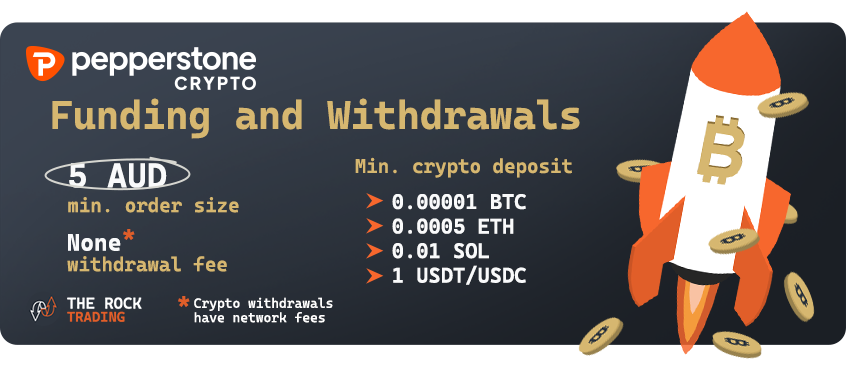
For AUD funding, Pepperstone Crypto uses bank transfer. There’s no headline “minimum deposit”, but you do have a minimum order size of 5 AUD, so that’s the practical minimum if you want to place a trade. Deposits need to come from a bank account in your own name, which is standard for AUSTRAC-style compliance.
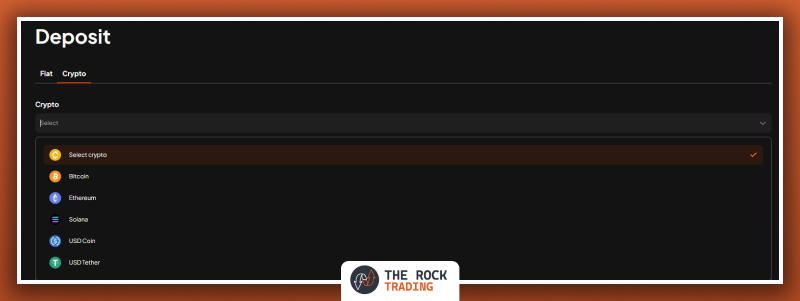
You can also fund with crypto straight into your Pepperstone Wallet. The crypto wallet sets minimum deposit sizes (so tiny test transfers don’t clog the system). The minimums start at 0.00001 BTC, 0.0005 ETH, 0.01 SOL, and 1 USDT/USDC. As with any exchange, crypto deposit speed mostly comes down to blockchain confirmations and network congestion, rather than the Pepperstone tech itself.
Withdrawal Methods and Times
Withdrawals are also designed around AUD bank transfer plus crypto withdrawals from your Pepperstone Wallet. On the AUD side, Pepperstone Crypto doesn’t charge a fee to withdraw AUD (your bank can still apply fees), and it processes withdrawals 24/7, but the final arrival time can still depend on your bank.
There are also clear limits on AUD withdrawals with a 2 AUD minimum and 10,000 AUD maximum per transaction, which is fine for most retail users but can be restrictive if you’re moving larger amounts and don’t want to split withdrawals.
For crypto withdrawals, the main cost isn’t a Pepperstone fee as such it’s the network fee, which varies depending on the coin and the blockchain load at the time. Timing is similar, Pepperstone processes the request, but you’re still waiting on the chain for confirmations.
Security-wise, withdrawals use step-up checks, and you’ll generally need to verify a new withdrawal address before sending out, which is exactly how it should be on an exchange account.
If you’re coming from an international crypto exchange like Binance or Coinbase, expect fewer funding options and fewer advanced withdrawal controls, but a cleaner AUD-focused experience that should suit most Australian retail traders
Risk and Trading Rules
On Pepperstone Crypto, the main trading rules you need to understand about are simplier than prop firms and brokers as this is spot trading (not CFDs). So your trades are validated against your available balance (ie no leverage), and the exchange actively limits behaviour it sees as market abuse. It’s built for straightforward buy/sell and transfer use, not leveraged crypto trading.
Allowed Crypto Trading Strategies
You can trade actively, but Pepperstone Crypto is clear that it monitors for, and restricts, behaviour it treats as manipulation.
It explicitly bans strategies and patterns such as:
- wash trading
- spoofing
- layering
- trading using inside information
It also states it runs continuous market surveillance. If your trading activity is flagged, the online exchange can restrict how orders are placed (for example, limiting you to cancel only or specific order types) to protect market function.
If you’re using automation, it also applies API rate limits, which is normal on exchanges to reduce abuse and keep systems stable.
So manual trading and sensible automation are fine, but anything that looks like market manipulation (or generates harmful order flow patterns) is likely to get blocked.
Geographic Restrictions
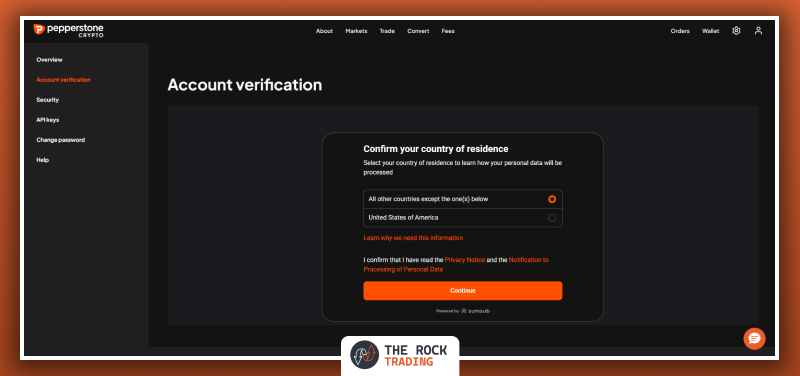
Pepperstone Crypto is Australian traders only at the moment. The eligibility rules require you to be an Australian resident and have a verified Australian bank account with an ADI in the same name as your Pepperstone Crypto account.
If you’re outside Australia you can still trade crypto CFDs via the Pepperstone brokerage, and we expect the exchange to expand internationally quickly as it’s such an established brand globally already.
Pepperstone Crypto’s Final Score
We scored Pepperstone Crypto 87/100 overall using our equal weight six pillar methodology (Fees, Platforms, Funding, Markets, Safety, Rules). The score is driven by strong fundamentals for Australian spot traders with simple 0.1% pricing, a clean TradingView-style platform, and an AUD-native funding setup that’s easy to use. Safety and rules also land well because the exchange is AUSTRAC-registered, has sensible account security features, and has been established by a major CFD and forex broker regulated by various financial authorities worldwide.
The reason it doesn’t push higher is they are rolling out with a smaller coin list and Australia-only access limits market breadth and overall flexibility versus bigger global exchanges. But if Pepperstone Crypto expands asset coverage and starts operating in other financial hubs, without sacrificing pricing and usability, their score will increase over 90.
How We Scored Pepperstone Crypto
The table below shows how we tested and scored Pepperstone Crypto, leading to an overall score of 87/100. Each category is weighted equally. Overall score maths: (9+9+8+7+9+10) ÷ 6 = 87/100 (rounded)| Category | Score | Why it scored this way |
|---|
| Fees | 9/10 | Flat 0.1% commission is easy to understand, and spot trading means no CFD-style overnight funding. Spreads still vary, so it’s not a perfect 10. |
| Platforms | 9/10 | TradingView-style web + app with the core order types and market data, but it’s still a simpler toolset than the big global exchanges. |
| Funding | 8/10 | Clean AUD bank transfer + crypto wallet transfers cover the basics well for Australians, but it’s not as flexible as exchanges with cards and multiple fiat rails. |
| Markets | 7/10 | Only 5 assets at launch. It covers majors/stables, but the limited coin range is a real cap for most active traders. |
| Safety | 9/10 | AUSTRAC-registered setup plus sensible security controls (2FA, withdrawal controls) and standard custody practices. Not AFSL, so avoid scoring it as “max protection”. |
| Rules | 10/10 | Clear spot-first rules with explicit market abuse bans and monitoring, and no leverage complexity to trip most retail users up. |
Visit Pepperstone