Crypto Trading Fees
KuCoin uses a tiered Maker/Taker fee model with trading costs structured around a 12-level VIP system where your tier is based on either your 30-day trading volume or your KCS holdings. VIP Tiers offer scaled benefits such as reduced commissions and higher withdrawal limits.
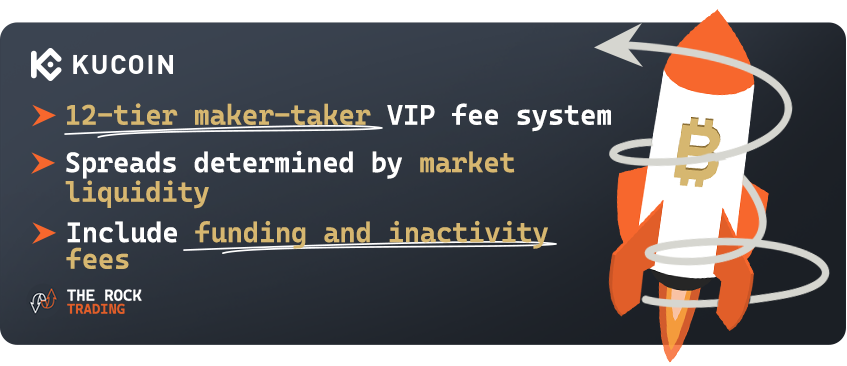
For retail users (Tier 0), KuCoin has a base fee of 0.1% for both Makers and Takers similar to Binance, and you can further reduce these costs by opting to pay fees with their native KuCoin Token (KCS) which lowers the rate down to 0.08%.
KuCoin also has a Unified Trading Account (UTA) for managing spot, margin, and futures trading from a single account in which you can leverage multiple assets as shared margin.
Base Maker–Taker Fees Across Major Exchanges
This table compares the base maker and taker trading fees across several major crypto exchanges| Platform | Base Maker Fee | Base Taker Fee | Native Token Discount |
|---|
| KuCoin | 0.10% | 0.10% | 20% (with KCS) |
| Binance | 0.10% | 0.10% | 25% (with BNB) |
| Coinbase | 0.40% | 0.60% | None |
| Kraken Pro | 0.16% | 0.26% | None |
For Futures trading, the fee structure starts at 0.02% for Makers and 0.06% for Takers. As you move up the VIP tiers, Maker fees can eventually drop to 0% or even become negative as rebates.
Spread and Pricing Transparency
KuCoin’s crypto spreads are dictated by the global order book rather than a broker’s markup, and highly liquid pairs like BTC/USDT have a bid-ask spread that’s as low as 0.01% to 0.02% during normal market conditions. While the spreads are tight for major coins, spreads for low-cap altcoins with thinner order books may widen because of slippage.
Typical Spread Comparison Across Exchanges
This table compares the approximate spreads for several trading pairs across different crypto exchanges.| Trading Pair Spread | KuCoin | Binance | Coinbase |
|---|
| BTC/USDT | ~0.01% | ~0.01% | ~0.02% |
| ETH/USDT | ~0.02% | ~0.02% | ~0.02% |
| SOL/USDT | ~0.04% | ~0.03% | ~0.05% |
| KCS/USDT | ~0.05% | None | None |
The platform’s transparency is also owed to the Fair Price Marking system which uses an index of prices from multiple major exchanges to prevent unnecessary liquidations during periods of local volatility.
Other Trading Fees
While KuCoin does not charge account maintenance fees, there is a dormancy fee of 2 USDT or 0.5% of assets for inactive non-KYC accounts, and a €3 monthly inactivity fee for KuCard users if you haven’t made any transactions within a 90-day period.
For leveraged overnight holding, you may pay funding fees depending on the markets, as the fees are dynamic and change hourly.
Futures traders exchange funding fees every 8 hours to align perpetual prices with spot rates, and the fees range between 0.01% and 0.03%.
If you’re margin trading on borrowed funds, the interest rates are determined by market supply and demand, though KuCoin may introduce monthly promotions that may offer 0% interest.
KuCoin scores a 7/10 in the fee category due to its order book spread transparency, 0.1% base rate, and the 20% discount provided by KCS. However, the score is lowered because of complex funding rates, and the inactivity fees may catch some casual retail users off-guard.
Crypto Markets
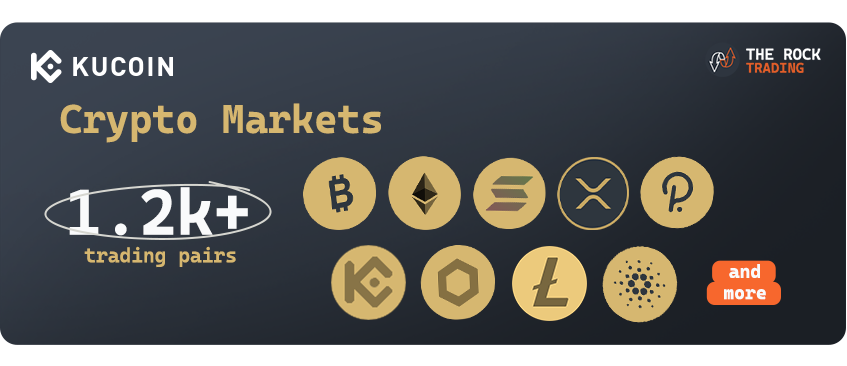
KuCoin provides access to over 1,000 listed tokens and more than 1,200 pairs, as of 2026. Their market types include Spot Trading, Futures (Perpetual and Delivery), Margin Trading, and Leveraged Tokens, catering to both retail HODLers and high-frequency traders.
The exchange also has a Unified Trading Account (UTA) which allows users to cross-margin across different market types and consolidate assets into a single account.
Trading with their native KuCoin Shares (KCS) token can have fee discounts and a daily bonus based on 50% of the exchange’s trading revenue, and you can also generate yield on crypto holdings through products like KuCoin Earn.
Available Cryptocurrencies
KuCoin’s market is distinguished by its listing speed and variety, often hosting breakthrough projects months before they appear on larger, more conservative exchanges like Coinbase.
Alongside major assets like Bitcoin and Ethereum, the platform focuses on the altcoin market with an array of small-to-mid-cap projects, and their listing categorization covers AI-based tokens, DePIN, Meme coins, Layer-2 scaling solutions, and various other types.
Typical Minimum Spreads by Cryptocurrency Pair
This table lists the typical minimum spreads for selected cryptocurrency trading pairs along with their category.| Symbol | Cryptocurrency | Category | Minimum Spread (Typical) |
|---|
| BTC/USDT | Bitcoin | Major | 0.01% |
| ETH/USDT | Ethereum | Major | 0.02% |
| SOL/USDT | Solana | Major | 0.03% |
| XRP/USDT | Ripple | Major | 0.04% |
| PEPE/USDT | Pepe | Memecoin | 0.08% |
| KCS/USDT | KuCoin Token | Exchange | 0.05% |
| LINK/USDT | Chainlink | Oracle | 0.05% |
| DOT/USDT | Polkadot | Layer 0 | 0.06% |
| ADA/USDT | Cardano | Layer 1 | 0.06% |
| LTC/USDT | Litecoin | Legacy | 0.05% |
| XMR/USDT | Monero | Privacy | 0.09% |
| ARB/USDT | Arbitrum | Layer 2 | 0.05% |
KuCoin also has a specialized hub that supports early-stage projects found within their GemSPACE ecosystem.
- Spotlight KuCoin’s premier token launches
- GemPool which allows staking for new assets
- GemVote where users democratically influence which projects are listed
This altcoin hub model allows you to discover projects with higher volatility and growth potential, and there are also passive income opportunities through KuCoin’s staking, savings, and lending features.
Entering 2026, KuCOin has also started listing Tokenized RWAs (Real World Assets) like state-backed tokens that offer government-bond yields with 24/7 blockchain liquidity.
Fiat-To-Crypto Trading
KuCoin’s multi-layered fiat-to-crypto model combines traditional finance with digital assets across 41 fiat currencies. Unlike exchanges like Uniswap that only pair crypto against stablecoins, KuCoin supports Direct Fiat Pairs for major currencies, and allows you to trade BTC/EUR directly on the spot market.
For entering the market, the Fast Trade suite lets you buy crypto instantly. For off-ramping, the Sell-to-Card feature lets you convert USDT or BTC back to fiat currencies and withdraw directly to a Visa or Mastercard within minutes.
The P2P exchange acts as a decentralized escrow service for buying and selling cryptocurrencies between users with over 200 payment methods like SEPA, Revolut Pay, and other local e-wallets. There’s also a conversion tool that allows beginners to swap between fiat-backed stablecoins and digital assets without the complexity of a live order book.
Trading Pairs and Liquidity
For major trading pairs liquidity on KuCoin is deep thanks to its execution quality based on a low-latency matching engine. It can handle thousands of transactions per second with minimal downtime, and supports execution during periods of extreme market volatility.
Long-tail niche tokens may experience higher slippage during periods of extreme volatility. To mitigate this, KuCoin uses a Fair Price Marking system for its futures market, and uses index prices from multiple exchanges to prevent scam wicks.
The platform earns a 6/10 for asset diversity and fiat-to-crypto accessibility, while the off-limits jurisdictions, the FMA’s recent restrictions, and lack of universal regulatory stability lowers the rating.
Trading Platforms and Tools
KuCoin has a Web Platform, a Mobile App, and a dedicated Desktop Client for macOS and Windows, and it also integrates TradingView directly into its proprietary interface for advanced technical analysis.
Their interface can be toggled to either Pro for experienced traders, or Lite for a more simplified dashboard to suit different experience levels. The platform is available globally to all account types, excluding restricted regions like the USA and Canada.
As for addons, KuCoin uses both native and third-party integrations for automation and convenience features, and they allow API keys and Docker ports for external addons like 3Commas, CoinLedger, Hummingbot, and others.
Web Platform
KuCoin’s Web platform is the primary hub for professional traders looking for a standard, multi-monitor setup for high-frequency execution and deep market analysis. The customizable layout allows you to drag, drop, and resize modules like the order book, depth charts, and recent trades to fit your workflow.
The platform is suitable for advanced and institutional traders who frequently use the Unified Trading Account (UTA) which enables margin sharing across Spot, Margin, and Futures markets. However, the web version is known for instability issues and may crash.
For a more simplified view for asset management, you can use the Funding Account verison of the web platform. The Trading Account version gives you the full suite of TradingView charting tools and algorithmic API keys.
Mobile App
The KuCoin Mobile App is made for on-the-go retail traders, and has a dual-interface system that lets you toggle to either Lite Mode for beginners, or Pro Mode for advanced trading.
Lite Mode simplifies the interface without complex order books and charting, and just leaves one-tap Buy/Sell and Earn features. Pro Mode is similar to the web experience, and has a bigger overview with trading bots, Futures, Quick Trade widgets for instant execution, and others, but the features may be very convoluted for some traders.
The app’s standout features is its integrated AI Trading Bot that lets you deploy Grid, DCA, and rebalancing different strategies without coding. If you’re a VIP Tier user, you have access to the enhanced Institutional Dashboard within the app for tracking large-scale portfolio health and OTC (Over-the-Counter) liquidity.
Desktop App
The KuCoin Desktop client mirrors the web version with access to Spot, Futures, UTA, but it offers a faster, distraction-free trading experience with better stability, lower resource consumption, and Full Screen and Professional layouts.
The main standout feature is the API High-Frequency (HF) Trading Account which offers dedicated, low-latency endpoints for algorithmic execution. Desktop version VIP users can also gain access to the Market Events and Whales Watch features for real-time monitoring of large-scale orders.
While it’s available globally for all account types, it’s the preferred choice of day traders looking for better monitoring, multi-account management, faster execution, and not having to constantly switch tabs like on the web version.
Charting, Indicators, and Order Types
KuCoin’s charting is powered by a native integration of TradingView with over 100 technical indicators and an array of drawing tools like Fibonacci retracements, Gann fans, and Elliot waves. You can switch between Basic, TradingView, and Depth views to visualize market sentiment.
The 2026 update has AI-predictive indicators that analyze historical volume patterns for finding potential support and resistance zones in real-time. The platform also supports a range of order types:
- Post-Only: Lets you act as a Maker to earn fee rebates.
- Hidden Orders: Allows large institutional trades to remain invisible on the public order book.
- Iceberg Orders: Splits large orders into smaller portions to minimize slippage.
- Trailing Stop: Dynamically follows the market price to lock in profits during a trend.
- Advanced OCO (One-Cancels-the-Other): Combines a limit and stop-limit order to manage both entry and exit simultaneously.
We give KuCoin’s platform suite a 7/10 for its versatile and retail-friendly accessibility that’s similar to ByBit’s interface. There’s native TradingView integration, UTA, and essential tools and charting features, but it loses three points because of the web version’s instability issues, and the overly complex Pro mode.
Safety and Regulation
KuCoin operates largely as an offshore entity registered in the Seychelles, setting it apart from strictly regulated brokers like Coinbase or Kraken. This offshore approach allows for a broader asset selection, but reduces the level of consumer protection and legal recourse available to traders.
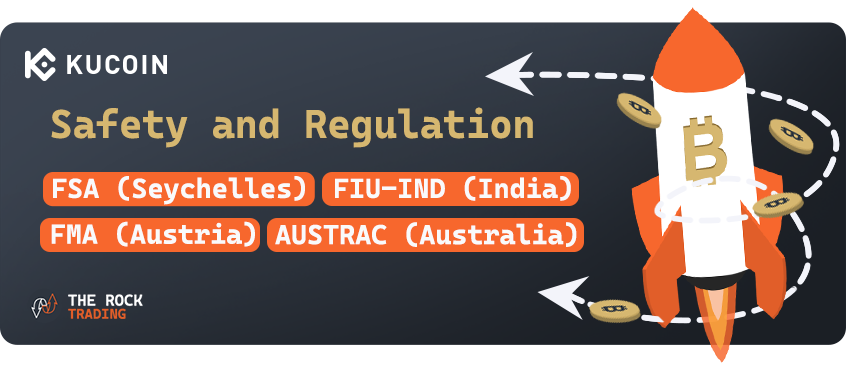
While it serves more than 200 regions, it lacks a primary Tier 1 financial license like from the UK’s FCA or the US’s SEC, and it only relies on a decentralized registration model across several jurisdictions. As for protection, KuCoin follows standard security practices in line with those used by other financial and technology firms.
Is KuCoin safe to use?
Technically, KuCoin is a safe to use, secure platform that has a ISO 27001, multi-signature cold storage fund protection, $1 billion insurance fund, SOC 2 Type II certifications, received accolades from Forbes, and monthly Proof of Reserves audits with over 100% backing.
However, it’s a high-risk firm from a regulatory standpoint because the lack of Tier 1 oversight means there is no government-backed deposit insurance to assist in the event of a platform-wide legal freeze.
Regulation and Licenses
KuCoin holds registrations and licenses with the following authorities:
- FSA (Seychelles): The primary regulator for its global entity, Peken Global Limited.
- FIU-IND (India): Registered as a Virtual Asset Service Provider (VASP) for AML compliance.
- AUSTRAC (Australia): Registered as a Digital Currency Exchange for local fiat operations.
- FMA (Austria): Holds a MiCAR-compliant license through KuCoin EU Exchange GmbH, though this is currently under administrative restriction.
Custody and Asset Storage
As a CEX, KuCoin uses a hybrid custody model in which over 90% of user assets are centralized and backed 1:1, and are kept in offline cold storage. The cryptocurrency exchange regularly publishes Proof of Reserves audits via Real-Time Merkle Tree to maintain security standards. For active trading, a small percentage is held in Hot Wallets for immediate liquidity.
Their proprietary, non-custodial KuCoin Web3 Wallet gives you full control and responsibility of your private keys in a decentralized environment. The wallets are protected by Multi-Party Computation (MPC) and multi-signature authorization that require multiple geographically dispersed keys to move funds.
However, in September 2025, FINTRAC imposed a $19,552,000 penalty on KuCoin for non-compliance with the Proceeds of Crime (Money Laundering) and Terrorist Financing Act.
Account Security Features
KuCoin’s security measures for user accounts include advanced encryption and multi-layer authentication. The multi-layered security framework addresses vulnerabilities, data protection, user privacy, and global compliance standards.
KuCoin employs a multi-layered security framework to protect user accounts:
- Multi-Factor Authentication (MFA): Supports Google 2FA, SMS, and email verification.
- Trading Password: A secondary 6-digit code required for all trades and withdrawals.
- Anti-Phishing Code: Personalized text included in official emails to verify authenticity.
- Withdrawal Whitelisting: Restricts fund transfers to pre-approved addresses only.
- Device Management: Real-time monitoring of authorized login devices and IP addresses.
- Biometrics: Integration of fingerprint and facial recognition for mobile app access.
Their strict KYC (Know Your Customer) protocol, as well as KuCoin’s bug bounty and continuous security monitoring with regular third-party assessments, all work to protect user assets and data.
Regulatory Issues and Incidents
KuCoin has faced regulatory challenges in various jurisdictions, including fines and operational restrictions. They were accused multiple times of operating without proper registration as a securities and commodities broker-dealer.
In September 2020, KuCoin suffered a major security breach that saw $281 million of crypto assets stolen due to exposed private keys linked to crypto wallets. After the 2020 hack, KuCoin cooperated with exchange and project partners to recover $222 million (78%) of the stolen assets and worked with law enforcement to recover an additional $17.45 million (6%).
As of July 2022, the Ontario Securities Commission (OSC) alleged that KuCoin failed to comply with the province’s securities law and operated an unregistered crypto asset trading platform. The OSC permanently banned KuCoin from participating in Ontario’s capital markets and required it to pay a $2-million administrative penalty.
In December 2022, the Dutch central bank stated that KuCoin was operating in the Netherlands without registration and was not in compliance with the Anti-Money Laundering and Anti-Terrorist Financing Act.
Reports from February and March 2023 state that KuCoin has been accused of allowing users to transact using sanctioned Russian banks on its platform. The P2P platform allowed transactions using debit cards issued by sanctioned Russian banks, specifically mentioning Sberbank and Tinkoff.
In December 2023, KuCoin reached a settlement with the New York State Attorney General, agreeing to pay $22 million in fines and refunds.
In March 2024, the United States Commodity Futures Trading Commission (CFTC) filed criminal charges against KuCoin for violating U.S. anti-money laundering laws.
In January 2025, KuCoin pleaded guilty to violating the U.S. Bank Secrecy Act, and admitted to charges of operating an unlicensed money transmitting business. The firm agreed to pay nearly $300 million in fines and forfeitures.
In 2026, the firm’s regulatory standing has weakened because of aggressive enforcement in the Middle East and Europe. In March 2026, Dubai’s VARA issued a cease-and-desist for unlicensed activities, and Austria’s FMA prohibited new business for KuCoin EU after the firm failed to maintain mandatory AML and sanctions officers. These lapses highlight a struggle to transition from a “growth-first” offshore model to the “compliance-first” requirements of MiCAR and VARA.
KuCoin offers standard technical security and transparency via Proof of Reserves, but there’s a major risk of regulatory shutdown, asset freeze in major jurisdictions, and many regulatory incidents that stem from 2022. The 3/10 score reflects this, as well as the recent bans in Europe and VARA warnings in Dubai indicate that the platform remains a grey market entity that struggles with compliance.
Funding and Withdrawals
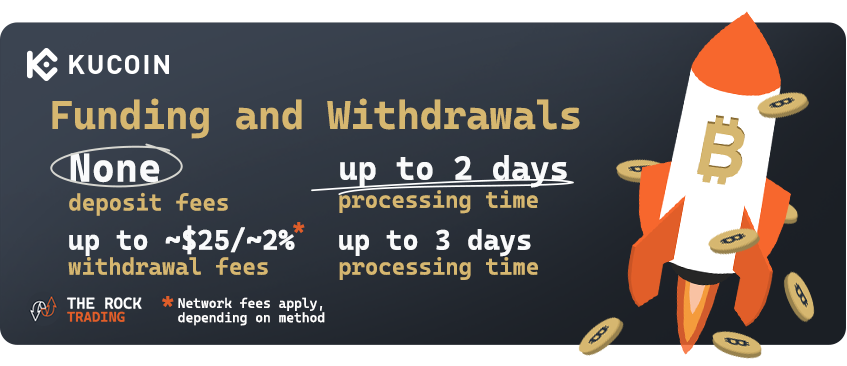
KuCoin uses a multi-channel funding model that supports on-chain deposits for over 1,000 assets, and integrates native crypto transfers with third-party fiat gateways. There’s Fast Trade funding for direct card purchases, P2P trading for zero-fee user transfers, and third-party channels like MoonPay.
Currency exchange fees vary by method. While P2P often carries no platform fee, Fast Trade and third-party providers charge a spread or a flat commission ranging from 1% to 3.5% depending on the currency.
Minimum Deposit Requirements and Methods
On KuCoin, there’s no minimum deposit for the account, but individual assets and methods have specific thresholds. For example, for on-chain crypto deposits, the minimum is very low around 0.00001 BTC, and KuCoin charges zero fees for incoming transfers.
However, fiat methods via the Fast Trade suite generally require a minimum of $15 to $30 or equivalent.
Deposit Methods and Fees
This table outlines the available deposit methods, their minimum deposit requirements, associated fees, and estimated processing times.| Method | Min Deposit | Fee | Processing Time |
|---|
| On-Chain Crypto | Asset Specific | 0% | 15-30 mins |
| Fast Trade (Card) | ~$20 | 1% - 3% | Instant |
| SEPA (EUR) | €1 | Fixed (~€1) | 1-2 Business Days |
| Third-Party (Google Pay, MoonPay) | ~$30 | 2% – 3.5% | 5-15 mins |
| P2P Trading | Varies by Seller | 0% | 5-15 mins |
Fiat funding via credit/debit cards may incur additional cash advance fees from your bank.
Withdrawal Methods, Fees, and Waiting Period
Withdrawals on KuCoin mirror the deposit model, and are subject to Dynamic Network Fees for crypto and flat service fees for fiat. There’s Sell-to-Card for near-instant off-ramping to Visa or Mastercard, as well as on-chain crypto withdrawals.
The fees vary by blockchain network, and usually cost 0.0002 BTC to 0.0004 BTC BTC to cover the on-chain miners’ fees. The Sell-to-Card feature allows you to use direct fiat withdrawals to bank cards with most transactions arriving within minutes.
Withdrawal Methods and Fees
This table summarizes withdrawal options, minimum withdrawal amounts, associated fees, and average waiting times.| Method | Min Withdrawal | Fee | Avg. Wait Time |
|---|
| Crypto (BTC) | 0.0005 BTC | 0.0002 - 0.0005 BTC | 10-60 mins |
| Crypto (USDT) | 5 - 20 USDT | $1 - $25 (Network dependent) | 5-20 mins |
| Sell-to-Card | ~$20 | 1% - 2% | 5-30 mins |
| SEPA (EUR) | €5 | ~€1 - €2 | 1-3 Business Days |
| P2P Market | No Minimum | 0% | 5-15 mins |
Standard crypto withdrawals are processed as soon as the platform’s internal security checks (usually 5–30 minutes) are complete. Fully verified (KYC’d) individual accounts have a 24-hour withdrawal limit of 200 BTC or equivalent, while unverified accounts are restricted from all trading.
KuCoin’s funding ecosystem scores a 7/10 for its versatility, supporting over 1,000 assets, 41 fiat currencies, and essential features like Sell-to-Card for off-ramping. Like on other exchanges, P2P remains fee-free, and though the mandatory KYC and third-party spreads can be bothersome, the funding model is acceptable for most traders.
Risk and Trading Rules
KuCoin maintains standard trading rules that combine automated risk management with strict adherence to its internal Anti-Abuse and Fair Trading policies. The platform’s rules are designed to prevent market manipulation, wash trading, and excessive volatility spikes within its order books.
For professional traders, these rules are particularly strict, and require compliance with the Unified Trading Account (UTA) risk parameters that enforce margin control across all sub-accounts. KuCoin’s real-time monitoring systems can temporarily suspend accounts if they notice irregular execution patterns.
Leverage and Margin Availability
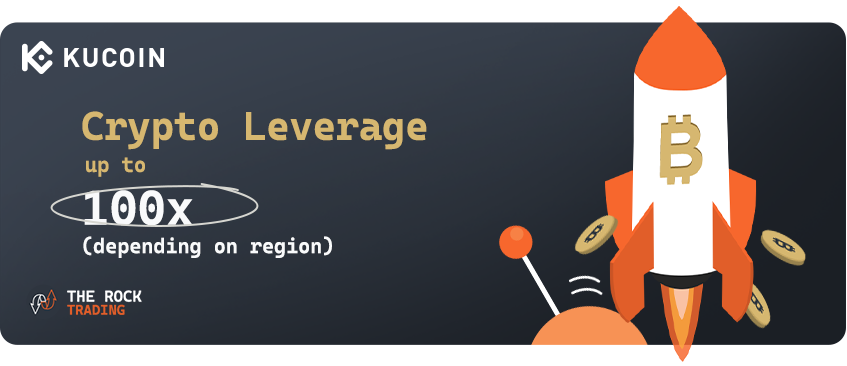
KuCoin offers a tiered leverage system tailored to asset liquidity and spot and futures trading, and it supports up to 10x leverage for cross margin trading, and up to 125x for perpetual futures on assets like BTC and ETH.
Under MiCAR regulations, the KuCoin EU entity enforces stricter leverage caps for retail users to 2x or 5x for most crypto-to-fiat pairs. Leverage availability is asset-dependent, as low-cap altcoins are typically restricted to 2x-5x leverage due to their volatility.
Leverage Limits by Region and Account Type
This table shows how maximum futures leverage varies depending on region, account type, and compliance standards.| Region | Account Type | Max Futures Leverage | Compliance Standard |
|---|
| European Union | KuCoin EU | 2x - 5x | MiCAR / FMA |
| Global (Offshore) | Standard / VIP | 100x | FSA (Seychelles) |
| India | VASP Registered | 100x | FIU-IND |
Professional traders with VIP status can unlock higher margin limits and lower maintenance requirements which is good for high-frequency scalpers.
Allowed Trading Strategies
KuCoin is permissive regarding diverse trading styles, and they officially support scalping, hedging, and high-frequency automation.
- Automation: Full support for custom bots and third-party tools via API 2.0.
- Copy Trading: The native Elite Trader program allows users to mirror professional strategies automatically.
- Hedging: Hedging is supported through the Dual-Direction mode in Futures, and it allows you to hold positions simultaneously on the same contract.
The platform’s flexible rulebook, high liquidity, and sub-millisecond API response times make it a decent choice for scalpers.
KuCoin Margin Trading
KuCoin’s margin operates on a liquidation model. If your Margin Level falls to 1.1, the system triggers a Debt Reminder. A Stop-Out liquidation occurs when the level hits 1.0, at which point the system automatically closes positions to repay the debt.
In the Cross Margin mode, the entire account balance is used to prevent liquidation, whereas Isolated Margin restricts risk to a single position.
Geographic Restrictions
KuCoin serves over 200 countries, but its availability is governed by a strict Restricted Locations policy to comply with local securities laws and AML mandates.
As of February 2026, the Austrian Financial Market Authority (FMA) has temporarily prohibited KuCoin EU from onboarding new customers or launching new products due to compliance staffing vacancies.
The following regions are strictly prohibited from all trading activities:
- North America: United States (all states and territories) and Canada (Ontario and British Columbia).
- Asia: Mainland China, Hong Kong, Singapore, and Malaysia.
- Middle East: Iran.
- Europe: Netherlands and sanctioned regions of Ukraine (Crimea, Donetsk, Luhansk).
KuCoin scores an 8/10 here for its permissive rule environment, liquidation model, and Hedge Mode offer decent flexibility. The score is capped by the strict MiCAR limits in Europe and regional bans in the US, but the overall model for leverage, regioanl availability, and trading flexibility makes it a solid choice for strategy-diverse traders.
KuCoin Final Score
KuCoin’s selection of over 1000 crypto assets and many features offers a system that can benefit many types traders who are looking for a sophisticated ecosystem. Tools like AI trading bots, low-latency API, dual-mode app, and the Unified Trading Account give you a standard experience similar to ByBit and Binance for both retail Gem hunters and institutional scalpers.
However, these achievements are severely undermined by a volatile regulatory profile that has been ruined even further in 2026. Despite obtaining a MiCAR license, the FMA’s February restrictions and total bans in North America highlight significant compliance gaps. The lack of Tier 1 oversight creates substantial legal risk for long-term holders.
Ultimately, KuCoin excels in innovation but falters in regulatory stability, and this ultimately pushes it to grey market territory which may not be attractive for most traders.
How We Scored KuCoin
This table outlines the scoring breakdown used to evaluate KuCoin across six equally weighted categories.| Category | Score (out of 10) | Why it scored this way |
|---|
| Fees | 7/10 | Competitive trading fees, but high spreads on third-party fiat gateways. |
| Markets | 6/10 | Massive selection of 1,100+ assets offset by regional restrictions. |
| Platforms | 7/10 | Native bots and professional desktop client. |
| Safety | 3/10 | Decent technical security, but lacks Tier 1 licenses and faces too many regulatory bans. |
| Funding | 7/10 | Versatile fiat options and free deposits with somewhat high third-party gateway fees. |
| Rules | 8/10 | Permissive hedging and scalping policies limited by strict EU leverage caps. |
Overall score maths: (7+6+7+3+7+8) ÷ 6 = 6.333 = 63.33/100 = 63/100 (rounded)