Trading Fees
eToro offers both spot crypto and crypto CFDs depending on your region, and each product has its own cost structure built around variable spreads and a 1% crypto fee.
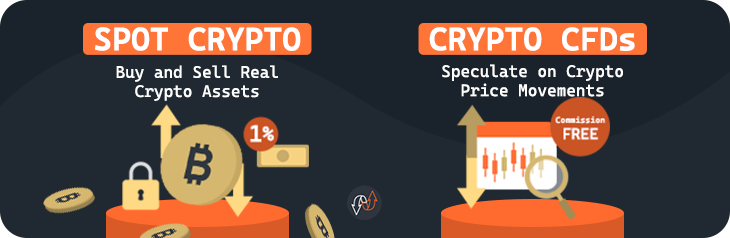
Spot Crypto Fees (Buy/Sell Real Assets)
When you trade spot crypto on eToro (x1, without leverage), you are buying and selling the underlying asset where permitted. Spot trades follow a simple structure:
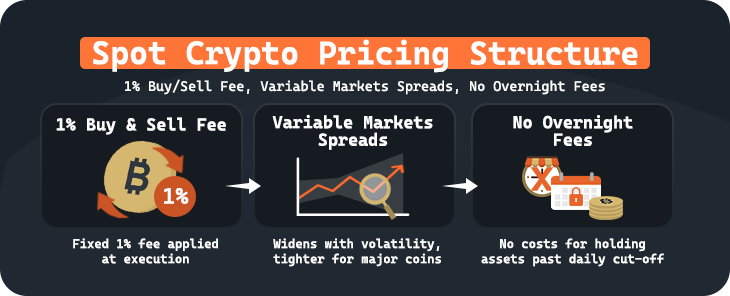
- 1% fee when you buy
- 1% fee when you sell
- Plus the live market spread
These fees are included in the execution price, so you see the total cost at the moment the order is filled. Because you are trading the actual asset, there are no overnight charges and no additional commissions.
Spot pricing applies in the US, UK, and in regions where crypto CFDs are restricted, or when you manually set leverage to x1.
Crypto CFD Fees (Region-Dependent)
In regions where crypto CFDs are allowed (EU under CySEC, Australia under ASIC, and certain international entities), pricing works differently:
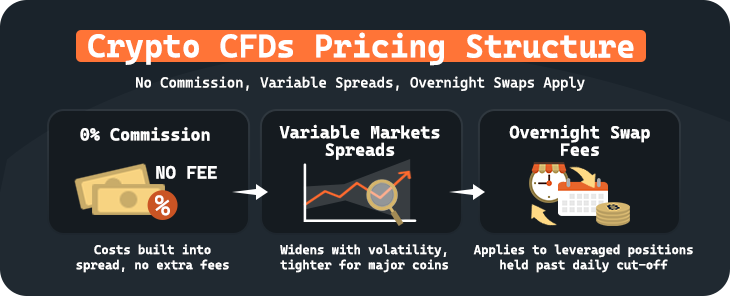
- You still see a variable market spread, but the cost is not tied to the spot 1% structure.
- No separate commission, as costs are included in the spread and swap fees.
- Overnight financing charges (swap fees) apply to leveraged or short CFD positions.
For CFDs, the fee model depends on leverage, asset type, and holding duration. This means CFD users face:
- Spread cost
- Swap fees if holding past the cut-off
- No 1% buy/sell fee if the trade is a CFD (the 1% fee applies only to spot)
This is where many traders mistakenly assume “1% applies to everything”, but it does not.
Spot = 1% buy + 1% sell
CFDs = spread + swap (no 1% fee)
Crypto Spreads
All crypto assets on eToro use variable spreads, and the platform does not publish fixed or average spread figures.
The spread you see for BTC, ETH or any altcoin reflects current market depth, liquidity, and volatility. eToro does not list typical spreads because they change constantly and differ between spot trades and crypto CFDs.
In practice:
- BTC and ETH usually show tighter spreads
- Altcoins widen during high volatility
- CFD spreads can differ from spot spreads because they follow CFD market feeds and liquidity sources
Regardless of the market, spot or CFD, the spread shown at execution is the live spread at that moment.
eToro Trading Account
eToro uses a single retail account type, so all traders operate under the same pricing structure for both spot assets and CFDs.
All crypto transactions use either the spot fee model (1% buy, 1% sell) or the CFD model (spread + swaps, where allowed). The eToro Club offers VIP-style perks such as reduced conversion fees and research access, but it does not reduce crypto fees or alter spreads.
eToro scores a 7/10 for fees because spot trading is easy to understand, but the 1% structure is higher than raw-spread exchanges for active traders. CFD users face swap fees and variable spreads, which is standard for leveraged products.
eToro Markets
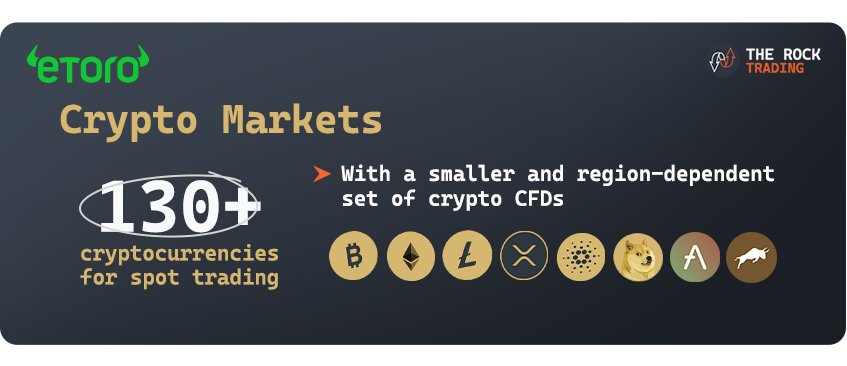
eToro offers up to 130 cryptocurrencies for spot trading, with a smaller and region dependent set of crypto CFDs alongside other major asset classes.
Spot Crypto Markets
On eToro you can trade a wide range of cryptocurrencies on a spot basis, where you buy and sell the underlying coin at x1.
In many international and EU regions the platform lists more than 130 cryptocurrencies, including major names such as Bitcoin (BTC) and Ethereum (ETH).
You also get popular altcoins like Cardano (ADA), Ripple (XRP) and Litecoin (LTC), as well as meme coins such as Dogecoin (DOGE) and Shiba Inu (SHIB) and a mix of DeFi and metaverse projects.
In the USA the spot list is smaller, typically around 50 cryptocurrencies, because some coins are restricted at a state level. The exact list of available markets always depends on your country of residence.
Crypto CFDs
eToro also offers crypto CFDs in regions where they are permitted by local regulation. This includes the EU under CySEC, Australia under ASIC and some international entities.
The CFD list is smaller than the spot list and focuses mainly on higher volume coins such as Bitcoin (BTC) and Ethereum (ETH), plus a selection of liquid altcoins.
Crypto CFDs are not available in the United States or the United Kingdom, so clients in those regions only trade spot cryptocurrencies without leverage. More detail on leverage limits and trading rules is covered in the Risk and Trading Rules section further down.
Other Markets at eToro
Alongside cryptocurrencies, eToro is a multi asset platform that also supports:
- Stocks and ETFs, including US and international shares
- Forex pairs, covering major and minor currency crosses
- Indices and commodities, such as stock indices and precious metals
For crypto focused traders this means you can keep coins, equities and ETFs in a single account. eToro also offers blockchain themed ETFs and staking on selected coins such as Cardano (ADA) and Ethereum (ETH) where local rules allow it.
The eToro Money app then provides a linked wallet for moving supported cryptocurrencies off the trading platform.
eToro scores 9/10 for markets, offering both spot and crypto CFDs. The overall coin selection is strong for spot trading, liquidity is generally solid on major pairs and trading is available 24 hours a day, seven days a week. The main drawbacks are the regional restrictions in the US and UK, and the fact that spreads can widen on less liquid coins during volatile periods.
Trading Platforms and Tools
eToro has its own proprietary web and mobile platform designed for ease of use, visible and simplified overview, and integrated social features such as CopyTrading and Smart Portfolios.
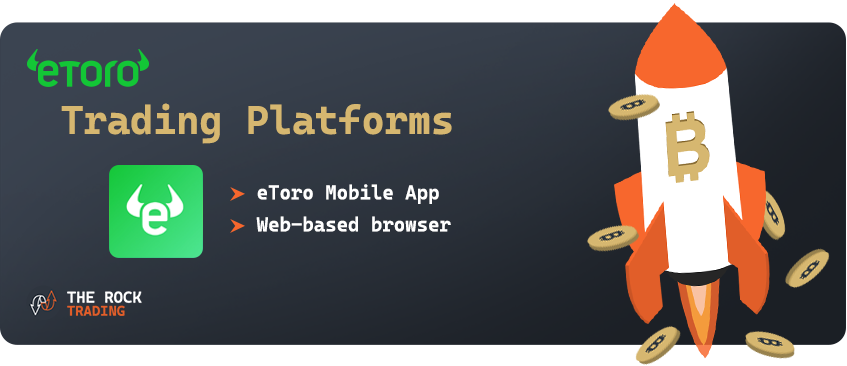
Unlike brokers such as Pepperstone, eToro does not support MetaTrader 4 (MT4), MetaTrader 5 (MT5), TradingView, or cTrader. This could be a major dealbreaker for traders, but it’s a deliberate choice to keep the ecosystem unified and focus on social trading as their unique selling point which is obviously catered to beginner traders, or traders who don’t like to juggle multiple apps and tools.
Proprietary Web Browser Platform and Mobile App
The web platform is simplistic, intuitive, and runs directly in your browser which is designed with simple functionality instead of complex technical interfaces. It includes ProCharts, a tool that allows you to compare multiple assets at once or view different timeframes when trading coins like Bitcoin or Ethereum.
The web platform offers a sentiment indicator, showing you what percentage of eToro users are buying or selling a specific asset. You also get access to research tabs and news feeds that are maintained by internal analysts and external partners.
The eToro mobile app is almost similar to the web experience. It allows you to buy cryptocurrency, manage your crypto portfolio, use real-time push notifications, price alerts, order executions, and engage with the community.
CopyTrader and Smart Portfolios
eToro’s standout feature is arguably CopyTrader, as it allows you to copy the performance of successful investors, and you can also filter traders by risk score, return, and asset class.
Unlike some platforms like MT4, it quickly integrates social networking with automated execution, and replicates the exact trades of investors. This creates a transparent platform that competitors fail to match in scope and simplicity.
Additionally, eToro has the Smart Portfolio feature which is an innovative, investment tool on eToro that’s also maintained by eToro’s expert analysts. This gives diversification and expert management with no extra fees, and it packs multiple assets around a specific market theme like tech. For example, a certain crypto portfolio might include multiple coins like BTC, ETH, LTC, or XRP weighted by market cap.
Add-ons and Tools
eToro’s extra tools focus on social trading, portfolio tracking, and education for crypto traders. CopyTrader and Smart Portfolios let you mirror other investors or trade pre-built baskets, while ProCharts and Trading Central cover more advanced technical analysis for active strategies.
Capitalise.ai, Delta Tracker, eToro Club, and eToro Academy then add automation, cross-exchange tracking, tiered perks, and structured learning, with access varying by web, mobile app, and Club tier.
| Tool/Add-on | Availability | Function |
|---|
| CopyTrader | Web and Mobile | Automatically follow and copy other traders' positions. |
| ProCharts | Web Only | Advanced technical analysis and comparison. |
| Delta Tracker | Mobile App | Track portfolios across different exchanges. |
| eToro Club | Web and Mobile | Tiered membership with perks like lower fees and exclusive content for third-party tools |
| Trading Central | eToro Club | Technical analysis signals for high-tier users. |
| Smart Portfolios | Web and Mobile | Pre‑built investment strategy baskets |
| Capitalise.ai | Limited | Automate trading strategies using plain English. |
| eToro Academy | Web and Mobile | Educational resources for beginner traders. |
eToro scores 6/10 for tools, platforms, and add-ons because it does not offer other platforms like MT4, MT5, or TradingView which can be a hindrance for traders who are used to platform integration. While it lacks MT4, the proprietary eToro platform is arguably one of the best for social trading and copytrading, Smart Portfolios, and ease of use because they provide solid value for utility that most standard platforms can’t match. Though the platform is transparent, simple, community-focused, and good for beginners, it lacks advanced functionality.
Safety and Availability
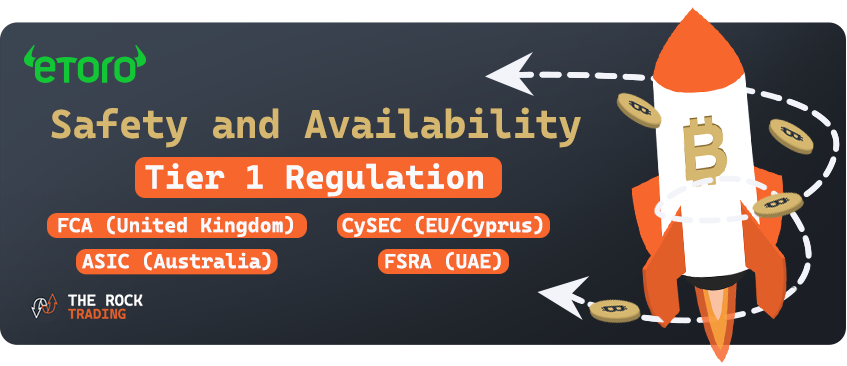
eToro operates under strict oversight from top-tier financial authorities such as FCA (UK), ASIC (Australia), FSRA (UAE), and CySEC (Cyprus). This ensures fund protection and company transparency, often giving your trading account more protection than prop firms or crypto exchanges. eToro is available in over 140 countries, except in Canada, Japan, Cuba, Iran, North Korea, Russia, Syria, and Turkey.
CFD, including crypto CFDs, are not available in the US. US traders generally trade the underlying crypto assets directly (or stocks and ETFs through a different eToro entity. The value of the crypto assets is not protected by SIPC or FDIC against market loss or firm failure. Valid NMLS ID information is available on their site for verification.
For US residents, eToro is registered with FinCEN for crypto trading in the US, but under a different name, eToro USA LLC, which is regulated as a Money Services Business with FinCEN. Under eToro’s US operations, you are buying and selling actual crypto, forex, and stocks, rather than CFDs. In compliance with regulatory requirements, eToro ensures the safety of client funds by keeping them segregated from the company’s capital for enhanced financial security.
Risk Controls and Protection
As a regulatory feature, eToro also gives retail traders who participate in leveraged CFD trading a Negative Balance Protection (NBP) feature that ensures that a client’s trading account balance cannot fall below zero, so they cannot lose more than their account balance. For cryptocurrency held as real assets (non-CFD), the assets are segregated from the company’s funds.
The broker operates largely on a Market Maker model for CFDs and an agency model for real stocks and crypto. While Market Makers often face scrutiny for transparency, eToro’s sheer size and regulatory standing since 2007 doesn’t raise any trust concerns, as their fees are transparent.
We give eToro a 9/10 its strong reputation, failsafe mechanisms, extensive KYC checks, and commendable transparency. With regulation from the FCA, ASIC, and CySEC, plus a long history, it is one of the safest venues to buy cryptocurrency. Though it lacks some specific banking regulation licenses, and some minor regional restrictions, eToro has a deserved Tier 1 regulatory status.
Funding and Withdrawals
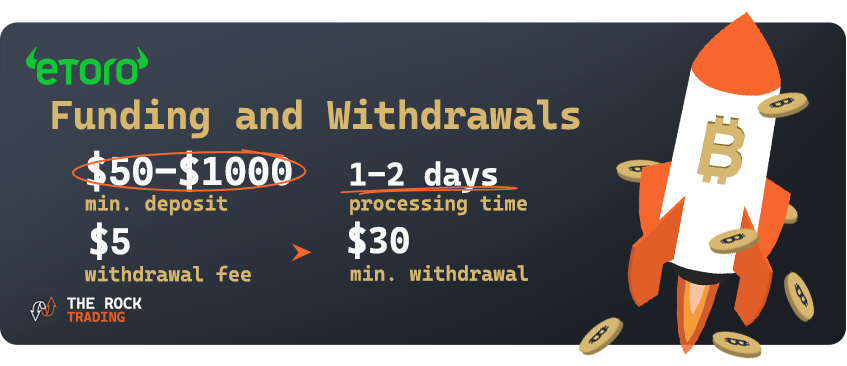
Deposits are free of charge on eToro, but the minimum deposit varies significantly. The minimum deposit in the UK, EU, US, and Australia is $50 (£39), while for other regions, it can range from $200 to $1,000.
All trading accounts are USD-denominated, and if you deposit in EUR, GBP, or AUD, a conversion fee is applied, which is a hidden cost.
Withdrawals are straightforward and fast, but carry a $5 fee per transaction, and the minimum withdrawal is $30. Unlike USD accounts, there is no minimum withdrawal amount for UK and European clients.
For UK and European accounts, there is no withdrawal fee when sending funds to external accounts like bank transfer, PayPal, Skrill, or Neteller.
Depending on which method you choose, processing times are typically 1-2 business days, but e-wallets like PayPal and Skrill are the fastest. eToro gives you access to a wide variety of payment methods.
- Credit/Debit Cards (Visa, Mastercard, Diners, Maestro)
- PayPal
- Neteller / Skrill
- Bank Transfer
- Crypto wallet
- Rapid Transfer / Klarna (Region specific)
- iDEAL for Netherlands
You can also use eToro Money to deposit funds instantly with no conversion fees in the UK and Europe. Regarding crypto funding, you cannot deposit cryptocurrency directly into the trading platform from an external wallet. You can only transfer crypto out of the trading platform to the eToro Money crypto wallet.
We give funding a 8/10 because it’s reliable and fast, but it’s not the cheapest. The variety of options like PayPal is good, but the forced USD conversion fees for EUR or GBP deposits and the $5 withdrawal fee prevent a better score.
Risk and Trading Rules
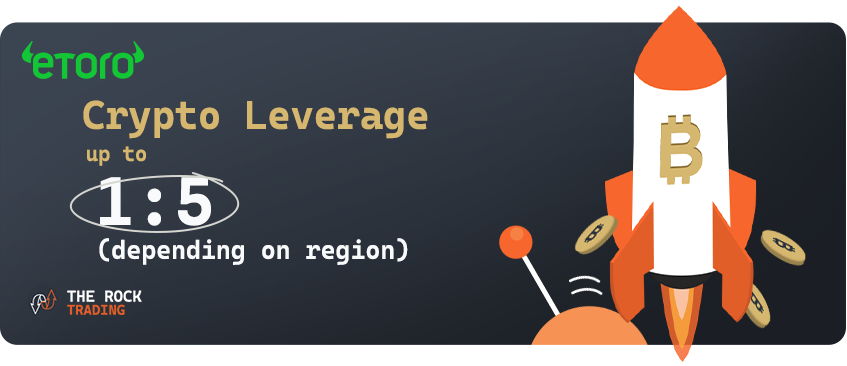
Due to the regulatory policies on regions, eToro’s cryptocurrency trading rules are based on the client’s geographic location. The retail client leverage limit for Crypto CFDs is typically 1:2 in the EU and Australia, while UK clients have a 1:1 limit for crypto CFDs.
eToro offers EU and International users both direct spot crypto trading x1 and Crypto CFDs. US clients can only spot trade crypto without leverage, and are prohibited from trading Crypto CFDs with leverage.
All crypto transactions across all regions are subject to eToro’s transparent 1% commission on both the buy and sell sides. Leveraged CFD trading has overnight financing fees, while spot crypto purchases are free from margin risk, making it unsuitable for high-frequency trading.
The trading rules on eToro are strict regarding verification, and you cannot trade anonymously because the extensive KYC (Know Your Customer) checks are mandatory for every trader. This ensures the safety of the ecosystem and compliance with blockchain regulations.
For allowed trading styles, eToro has the following policy:
- Scalping: Scalping is allowed, but is not profitable due to the 1% spread/commission on crypto trades.
- Hedging: Hedging is only allowed for CFDs so you can hold long and short positions on CFD crypto assets.
- Automation: While copy trading is supported, automated trading via third‑party bots is not.
Crypto Leverage Availability by Region
Depending on your region you can buy cryptocurrency or trade crypto CFDs with leverage for cryptocurrency spot trading, and there’s a 2x leverage (1:2 with 50% margin) for crypto CFDs. EU clients are limited to 2x leverage on crypto CFDs while traders in Australia or other jurisdictions may access higher ratios like x5.
Execution quality on eToro is generally reliable and fast, and is widely regarded as a market maker for CFDs and an agent for real assets. Liquidity is high for major pairs like BTC/USD and ETH/USD which is decent for day traders who are looking to enter and exit trades quickly.
However, the spreads can widen during periods of extreme market volatility.
| Region | Financial Regulator | Spot Crypto | Crypto CFDs | Max Leverage (CFDs Only) |
|---|
| Europe | CySEC | ✔ | ✔ | 2:1 |
| USA | FINRA, FinCEN/NMLS | ✔ | ✘ | NA |
| Australia | ASIC | ✔ | ✔ | 2:1 |
| UK | FCA | ✔ | ✘ | NA |
| International | FSA (Seychelles) | ✔ | ✔ | 5:1 |
Margin and Stop-Out
eToro has a 50% margin stop‑out rule, and traders should set manual Stop‑Loss and Take‑Profit orders on every trade to avoid forced liquidations. The platform enforces strict leverage caps for retail clients based on region, while offering tools to manage risk on every trade.
If your equity falls below 50% of the used margin, positions will be closed to prevent negative balances. For non-leveraged crypto buy orders, you own the asset which means there is no margin call risk unless you are borrowing funds.
eToro encourages responsible trading with their features like Risk Score for CopyTraders, which helps you assess if a trader’s strategy is too aggressive. For example, when going for heavy leverage on volatile coins like DOGECOIN or AAVE before copying them.
eToro scores 8/10 for their conservative risk rules which are suitable for managed risk trading. The leverage caps are designed to assist beginner traders from blowing up accounts and avoid unnecessary risks. The lack of support for high-frequency algorithmic scalping is very limiting for expert traders but it suits eToro’s target audience.
How We Scored eToro
We scored eToro 78/100 as a hybrid broker that combines a strong multi asset lineup and social trading tools with higher crypto fees and limited third party platforms.
eToro scores well for regulation, safety and ease of use, and its mix of spot cryptocurrencies, region dependent crypto CFDs, stocks and ETFs makes it a useful one stop account for many traders. The social layer, including CopyTrader and Smart Portfolios, plus the eToro Money wallet, adds value if you want to combine crypto with more traditional markets without juggling multiple platforms.
On the downside, crypto trading costs are higher than some specialist exchanges, spreads can widen on smaller coins and there is no MT4, MT5 or cTrader support. Overall, the 78/100 reflects a platform that suits traders who value regulation, simplicity and social features, while more cost sensitive or platform focused traders may prefer a lower cost CFD broker with deeper third party platform support.