Crypto Trading Fees
Bybit uses a volume-based maker taker model, so what you pay depends on how you place your order and how much you trade over a rolling 30 day period. If you add liquidity with limit orders that sit on the book, you pay the maker rate. If you remove liquidity with market orders or aggressive limits, you pay the taker rate. Your 30-day volume or asset balance determines your VIP tier.
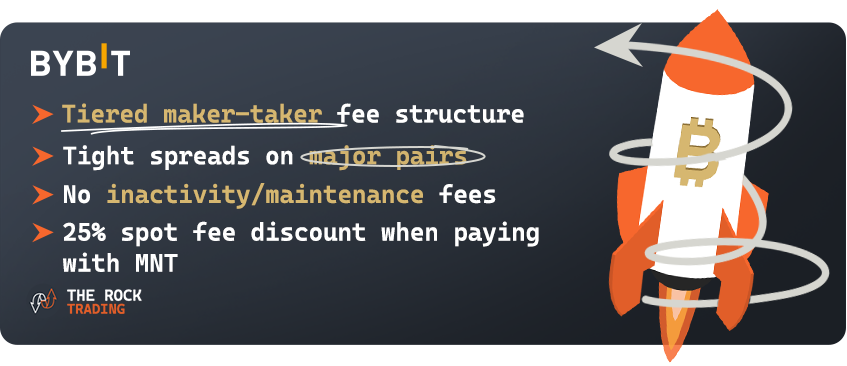
At the base level (VIP 0), fees are set at 0.10% maker and 0.10% taker for spot trading. On perpetuals and futures, the entry rate is 0.02% maker and 0.055% taker. Options start at 0.02% maker and 0.03% taker. That puts Bybit broadly in line with other large global exchanges at the retail tier, particularly on derivatives.
As your trading volume increases, fees decrease across both spot and derivatives. The full tier breakdown is below.
Bybit VIP Fee Structure (Spot, Perpetuals & Options)
The table below shows the standard maker and taker trading fees at each VIP tier based on 30-day trading volume or qualifying asset balance.| Tier | Spot (Maker/Taker) | Perpetuals & Futures (Maker/Taker) | Options (Maker/Taker) |
|---|
| VIP 0 | 0.10% / 0.10% | 0.02% / 0.055% | 0.02% / 0.03% |
| VIP 1 | 0.0675% / 0.08% | 0.018% / 0.04% | 0.015% / 0.02% |
| VIP 2 | 0.065% / 0.0775% | 0.016% / 0.0375% | 0.015% / 0.02% |
| VIP 3 | 0.0625% / 0.075% | 0.014% / 0.035% | 0.015% / 0.02% |
| VIP 4 | 0.05% / 0.06% | 0.012% / 0.032% | 0.015% / 0.018% |
| VIP 5 | 0.04% / 0.05% | 0.01% / 0.032% | 0.01% / 0.015% |
| Supreme VIP | 0.03% / 0.045% | 0.00% / 0.03% | 0.005% / 0.015% |
At higher tiers, derivatives maker fees can drop to zero, and under certain Pro classifications maker rebates may apply if you provide enough liquidity. Whether that’s relevant to you depends entirely on how much size you trade.
If you’re comparing exchanges, the key numbers to focus on are the base tier derivatives fees. Binance, for example, sits at 0.02% maker and 0.05% taker at VIP 0, which is slightly cheaper on the taker side. Coinbase Advanced uses a different retail pricing model for spot, often higher at low volumes, while derivatives fees are closer to industry norms.
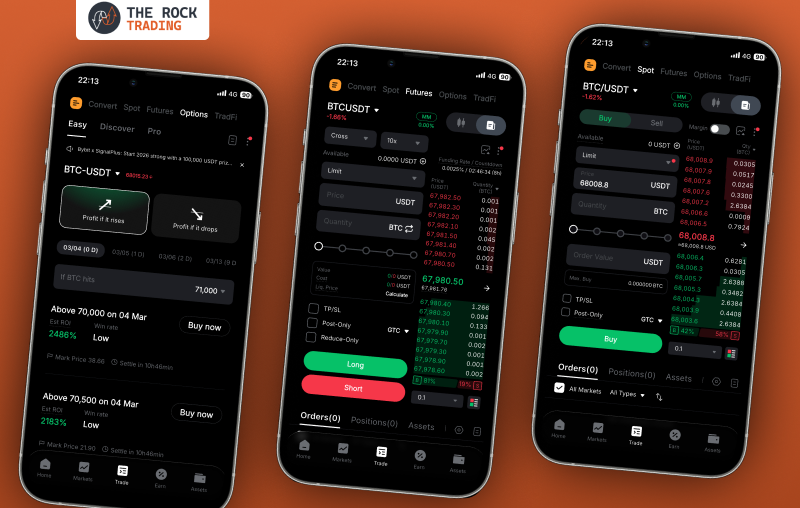
Funding Rates on Perpetual Contracts
Perpetual futures also include funding payments, which are separate from trading fees. Funding is exchanged between long and short traders, typically every eight hours. When funding is positive, longs pay shorts. When funding is negative, shorts pay longs.
If you hold positions intraday and close before funding windows, this may not matter much. If you hold overnight or for several days, funding can materially affect your net cost.
Unified Trading Account (UTA)
If you use the Unified Trading Account, your collateral is shared across spot, perpetuals, futures, and options. Unrealised profit on one position can offset margin requirements on another, which changes how efficiently your capital is used. It does not change the published maker–taker rates, but it does affect how much capital you need to keep positions open.
Spreads and Real Trading Costs
Your effective cost isn’t just the fee percentage. It’s the spread plus the fee. On high-liquidity pairs like BTC/USDT and ETH/USDT, spreads are usually very tight in normal market conditions. In testing, BTC/USDT often showed spreads around 0.01% to 0.02%, while ETH/USDT tended to sit slightly wider.
As you move into mid-cap and lower-cap tokens, spreads widen and order book depth thins out. That’s standard across exchanges, but it’s worth keeping in mind if you trade size in smaller pairs.
On derivatives, liquidations are triggered using a Mark Price rather than the last traded price. The Mark Price references an external index, which reduces the likelihood of brief price spikes on the exchange triggering unnecessary liquidations.
Other Costs to Consider
There are no inactivity or account maintenance fees. Your main additional costs come from liquidation fees, withdrawal fees, and funding.
If a derivatives position is forcibly closed, a liquidation fee can apply. This can reach up to 2% of position value depending on the contract and tier. Withdrawal fees are charged per asset and depend on the network you choose. For example, BTC withdrawals carry a fixed BTC fee, while stablecoin withdrawals vary significantly between ERC-20, TRC-20, and other chains.
Bybit also offers a fee discount program where paying spot trading fees in Mantle (MNT) can reduce spot fees by up to 25%, subject to the exchange’s terms.
Overall Fee Positioning
At the retail tier, spot fees are standard at 0.10%, and derivatives fees are competitive with other large offshore exchanges. Costs become more meaningful at higher volume levels, where maker fees drop and rebates may apply.
If you mainly trade perpetual futures, the 0.02% / 0.055% structure at entry level is the number that matters most. From there, your real-world cost will depend on whether you’re mostly hitting the book, providing liquidity, holding through funding periods, or trading thinner altcoin pairs.
Bybit scores a 8/10 for its transparent and competitive fee environment for derivatives which suits high-volume traders. The liquidation penalty system is fair, but it still means that inexperienced traders must carefully manage their positions to avoid unnecessary costs. The use of the MNT token, the Bybit Card, tiered structure, and a transparent Mark Price system, all maintain a relatively high score.
Crypto Markets
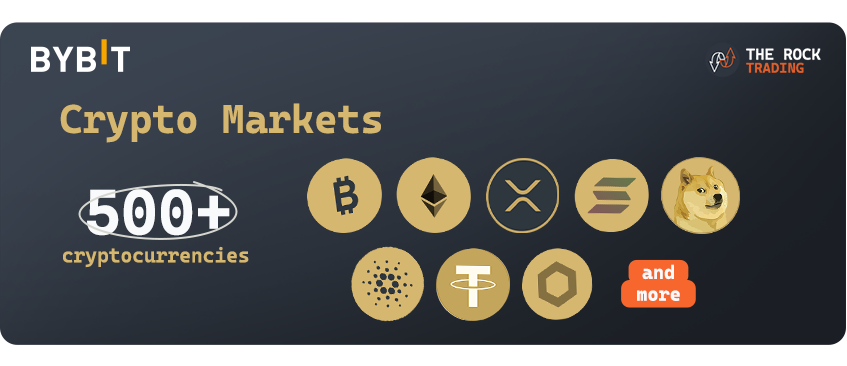
Bybit lists over 500 cryptocurrencies and more than 1,100 spot trading pairs, with most liquidity concentrated in USDT pairs. If you’re trading majors like BTC, ETH, or SOL, order book depth is generally strongest there. Smaller caps are available, but spreads widen and depth drops off quickly once you move outside the top tiers.
On spot markets, you’re buying and selling the underlying asset. You can withdraw coins to an external wallet or move them internally across sub-accounts. That’s different from trading crypto CFDs, where you only get price exposure.
On the derivatives side, Bybit offers perpetual futures, dated futures, and options. Most volume sits in USDT-margined and USDC-margined perpetual contracts, particularly on BTC and ETH. Liquidity thins out as you move into smaller altcoin perps, which is normal across exchanges. Leverage limits depend on the asset and your region, and larger position sizes automatically reduce the maximum leverage available.
Available Cryptocurrencies
The exchange covers large-cap coins, mid-caps, and newer tokens that tend to carry higher volatility. Listings are grouped into different zones based on risk profile and maturity. Established assets sit in the main trading zone, while newer or lower-liquidity tokens may appear in specialised sections with different margin rules or fee conditions.
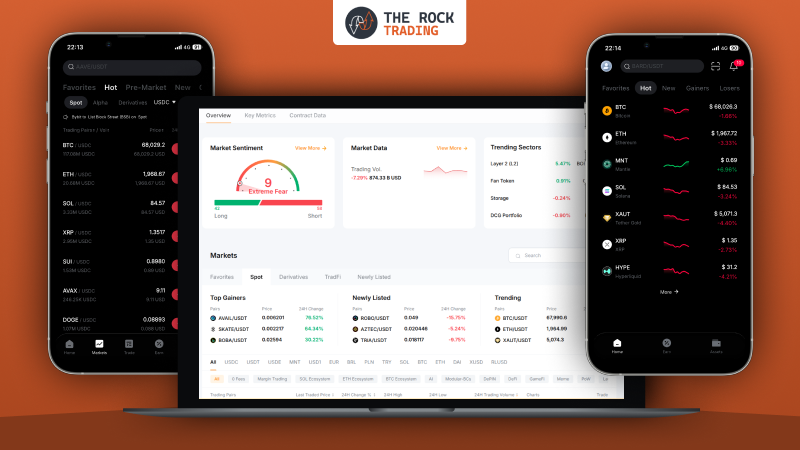
Bybit also integrates Mantle (MNT), which functions as both a listed token and part of the platform’s broader ecosystem. MNT can be used for fee discounts, collateral in certain products, and participation in platform programs, depending on eligibility.
Launchpad, Launchpool and Token Programs
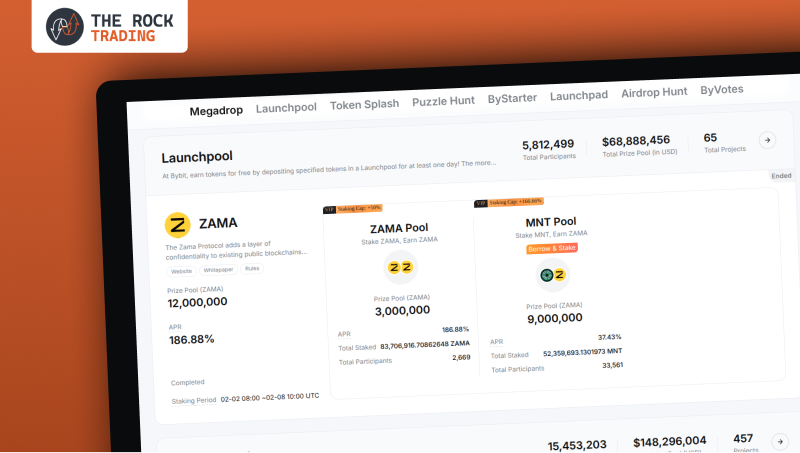
If you’re interested in early-stage tokens, Bybit runs a Launchpad and Launchpool. Launchpad gives access to token sales before open market trading, usually requiring staking or holding specific assets. Launchpool allows you to stake supported tokens to earn newly listed assets over a defined period.
These programs introduce additional risk compared to trading established coins, as pricing is less stable and liquidity can be limited in early stages.
Fiat-to-Crypto Access
Bybit supports fiat on-ramps through third-party providers, allowing deposits in currencies such as EUR, GBP, BRL, and HKD, depending on region. Processing times and fees vary by provider and payment method.
The platform also offers fiat balance functionality in supported regions, which lets you hold certain currencies before converting into crypto. Availability depends on your country and the entity you’re registered under.
Trading Pairs and Liquidity
Liquidity is strongest on major perpetual contracts such as BTC/USDT and ETH/USDT, where spreads are typically tight under normal market conditions. Order book depth decreases as you move into smaller-cap tokens or less common quote currencies.
Bybit states that its matching engine can process up to 100,000 transactions per second. In practice, execution quality on large-cap pairs is generally stable, though slippage increases during high volatility or thin
liquidity periods.
Liquidations on derivatives are based on a Mark Price derived from an external index rather than the last traded price. This is designed to reduce the chance of short-term price spikes triggering unnecessary liquidations.
Bybit’s market segment scores a 8/10 for their professional-grade environment for both yield seekers and high-risk speculators. The integration of the Mantle ecosystem and LSTs offers technical utility that few competitors can match. While the 300,000 USDT cap in the Adventure Zone shows responsible risk management, the sheer volume of high-risk assets requires a high degree of user competence.
Trading Platforms and Tools
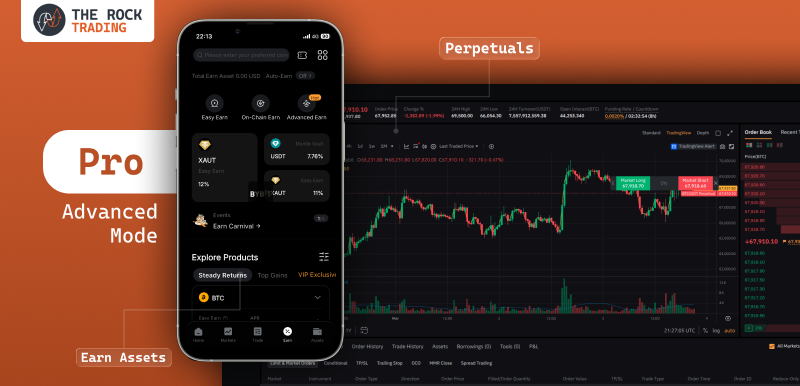
Bybit provides access to crypto spot and derivatives trading through web, desktop, and mobile platforms. You can trade perpetual futures, dated futures, options, margin, and spot markets from the same account, depending on your region and account type. The interface supports both a simplified layout and a more advanced trading view, so you can choose how much market depth and order detail you want on screen.
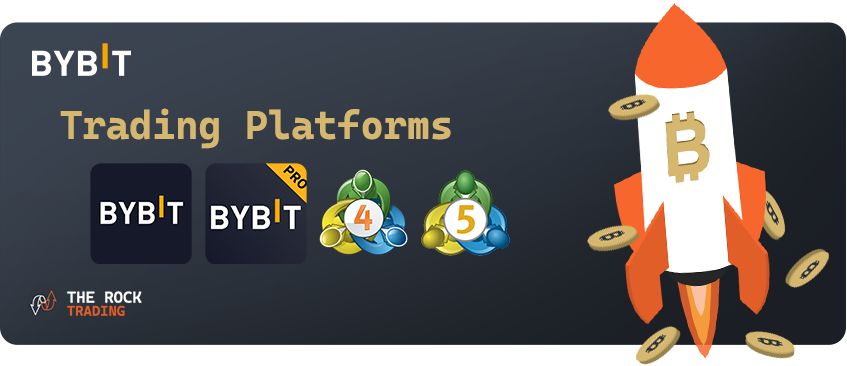
Bybit also integrates directly with TradingView for charting and connects to MetaTrader 5 (MT5) in supported jurisdictions for users trading forex or CFDs through affiliated entities.
Standard vs Pro Interface
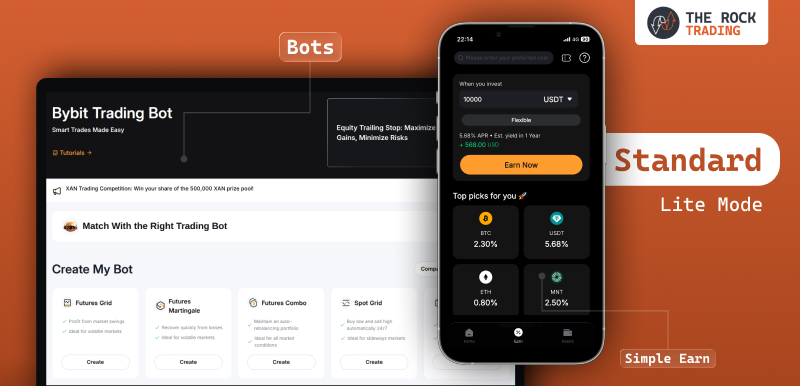
Bybit’s platform runs in two main modes with Standard (Lite) and Pro options. The table below outlines the functional differences between the two layouts.| Feature | Standard Mode | Pro Mode |
|---|
| Target User | Beginners, casual investors | Professional traders, day traders |
| Core Markets | Spot trading, Simple Earn, P2P | Derivatives (Perps/Futures), Options, Margin |
| Charting | Basic line or candle charts | Full TradingView integration, depth, ladder |
| Order Types | Market, Limit, basic TP/SL | OCO, Iceberg, Post-Only, Chase, Scaled |
| Automation | Simple DCA bots | Grid bots, Martingale bots, API webhooks |
Standard mode focuses on navigation and simple order placement. Pro mode exposes the full order book, advanced order types, and more detailed derivatives controls, including leverage adjustment and margin mode selection.
Web Platform
The web platform is the most complete version of Bybit’s trading interface. It supports both Standard and Pro layouts and works with Unified Trading Accounts. You can detach and resize charts, depth panels, and order entry modules, which makes it easier to run multi-pair setups on a single screen.
Advanced order types such as Post-Only, Iceberg, and conditional trigger orders are easier to manage on the web interface compared to mobile. If you trade perpetual futures actively or manage multiple positions, this is where most of the functionality sits.
Desktop Application
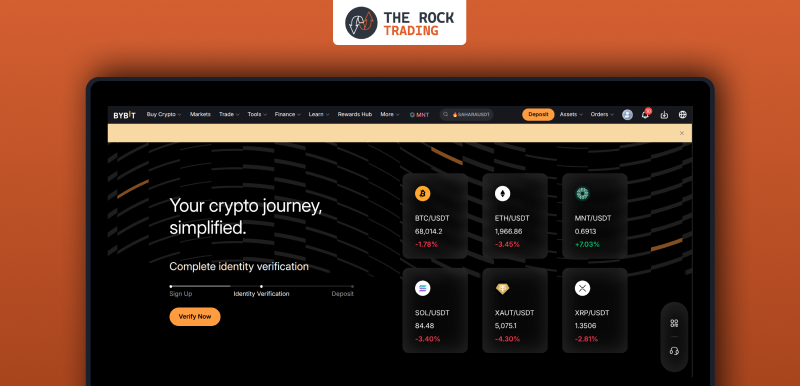
Bybit also offers a downloadable desktop app. Functionally, it mirrors the web platform but runs as a standalone application. This can reduce browser-related memory usage and allows for more stable multi-window layouts if you trade across several monitors.
The desktop version supports the same Pro trading tools, including hotkeys, depth-of-market views, and advanced order routing.
Mobile App
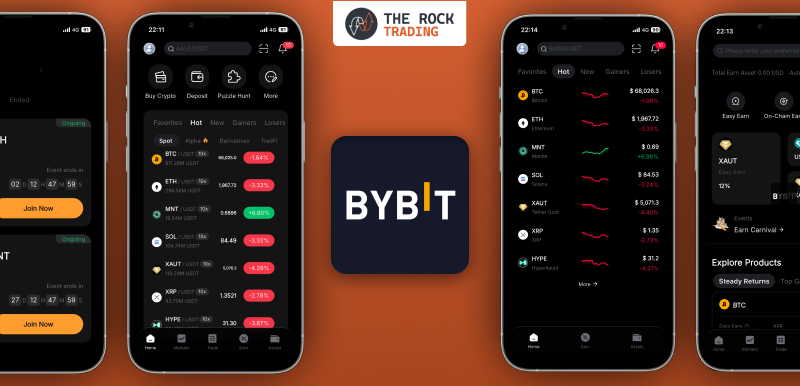
The Bybit mobile app lets you manage spot and derivatives positions from your phone. You can access perpetual contracts, options, wallet balances, P2P markets, and Earn products in one interface.
Charting is simplified compared to the full web version, but core tools such as technical indicators, order placement, and position management are available. The app also includes price alerts and biometric login security. App availability and features may vary by country.
Charting, Indicators, and Order Types
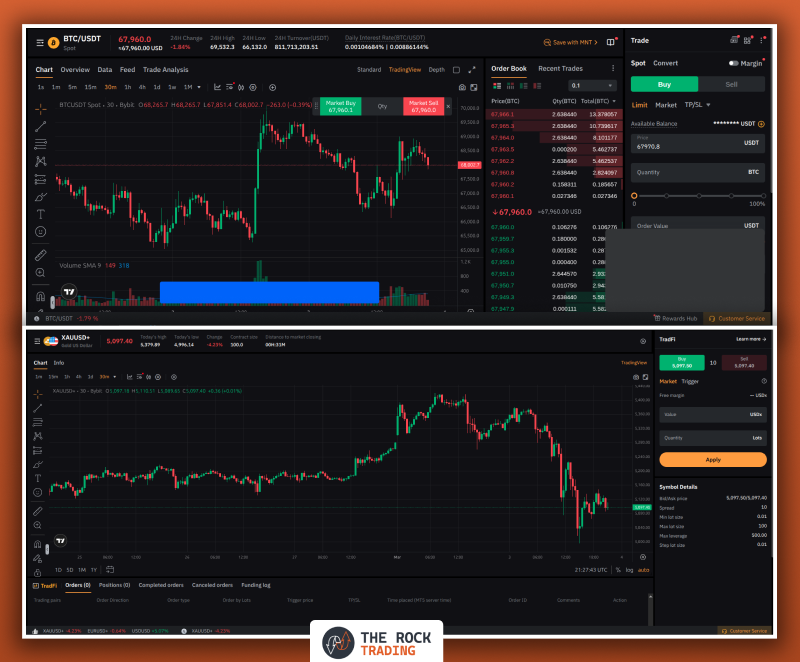
Bybit integrates TradingView charting directly into its Pro interface. You get access to a wide range of technical indicators, drawing tools, and timeframes, along with live order book depth.
Supported order types include:
- Market
- Limit
- Stop-Limit
- Conditional
- Post-Only
- Iceberg
- OCO (One Cancels the Other)
- Fill or Kill (FOK)
- Immediate or Cancel (IOC)
For derivatives trading, you can attach Take Profit and Stop Loss orders directly to a position. You can also switch between isolated and cross margin per position and adjust leverage before execution.
Market data tools include aggregated open interest, long/short ratio indicators, and funding rate history, which are useful if you trade perpetual futures actively.
API Access and Third-Party Integrations
Bybit provides API access for automated trading and external system integration. REST and WebSocket APIs are available, along with official SDKs in multiple programming languages.
Supported Integrations and Tools
The table below lists commonly used third-party platforms and technical integrations compatible with Bybit.| Tool / Platform | Access Type | Primary Use |
|---|
| TradingView Webhooks | Web | Automated signal execution |
| Official SDKs (Python, Go, Node, Java) | API | Bot development and data access |
| QuantConnect | External | Algorithmic trading |
| NinjaTrader | Desktop | External terminal integration |
| MultiCharts | Desktop | Strategy automation |
| Bookmap | Desktop | Order book visualisation |
| Altrady | Web/Desktop | Multi-exchange terminal |
| Backtrader | Python | Strategy backtesting |
Availability depends on account type and regional restrictions
Bybit’s platform suite scores a 8/10 because it’s among the most flexible in the crypto industry with its desktop, web, mobile, and vast addon integration. The 100k TPS speed and TradingView integration provide professional-level reliability for most traders. The score is only limited by the learning curve associated with its cluttered advanced menus.
Safety and Regulation
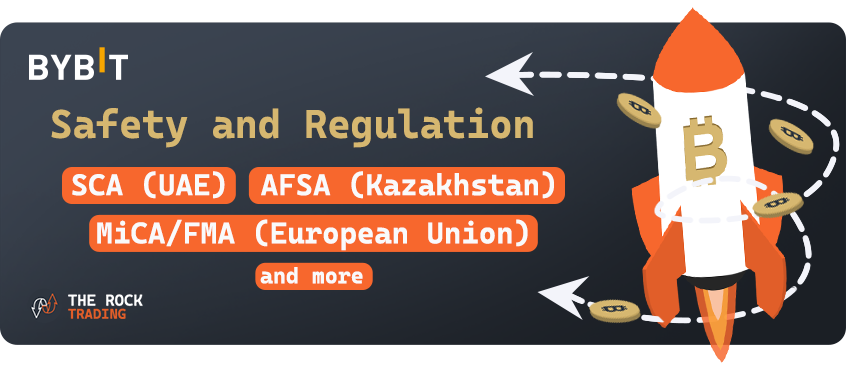
Bybit operates through multiple legal entities, and the level of regulation depends on the region you register under. The company relocated its headquarters to Dubai in 2022 and operates under regulatory supervision in certain jurisdictions, while other international clients are onboarded through offshore entities.
Bybit is not available to users in the United States. Access in the United Kingdom and some other regions is restricted depending on product type and local rules.
Regulatory Structure
Bybit’s regulatory position varies by entity. Based on publicly available information, it includes:| Jurisdiction | Regulatory Status | Scope |
|---|
| UAE | Licensed by VARA / SCA (Virtual Asset framework) | Virtual asset services in Dubai/UAE |
| European Economic Area | MiCA-related registration/authorisation (entity-based) | Crypto-asset services under EU framework |
| Kazakhstan (AFSA) | Licensed within AIFC | Regional crypto operations |
| British Virgin Islands | Offshore registration | Global operations entity |
Availability of products, leverage, and custody structure depends on which entity your account falls under.
Is Bybit Trustworthy?
Trust comes down to regulation, custody structure, operational history, and transparency.
Bybit publishes a Proof of Reserves (PoR) report that uses a Merkle Tree system to allow users to verify that liabilities are reflected in reported reserves. According to the exchange, reserves are maintained on a 1:1 basis. As with any exchange-issued PoR system, it verifies on-chain balances but does not replace a full independent financial audit.
In January 2023, India’s Financial Intelligence Unit fined Bybit for AML-related compliance breaches. This is part of its regulatory history and worth noting when assessing oversight standards.
Custody and Asset Storage
Bybit states that the majority of customer assets are stored in cold wallets that require multiple signatures for withdrawals. A smaller portion is held in hot wallets to facilitate day-to-day liquidity and withdrawals.
Cold storage typically reduces exposure to external attacks compared to fully online wallet systems, though it does not eliminate exchange counterparty risk.
For certain institutional clients, third-party custody solutions such as Zodia Custody are available. This allows assets to be held off-exchange while still being tradable, depending on the setup.
There is no investor compensation scheme comparable to those found in traditional securities markets. Client asset protection depends on the entity and jurisdiction.
Risk Controls and Account Security
Bybit requires identity verification for fiat services and for higher withdrawal limits. Withdrawal limits increase with higher verification levels.
Core account security features include:
- Two-Factor Authentication (Google Authenticator or hardware keys)
- Withdrawal address whitelisting
- 24-hour withdrawal lock after security changes
- Real-time monitoring for suspicious login or withdrawal activity
For derivatives trading, Bybit operates an insurance fund and auto-deleveraging system to manage extreme liquidation events. The platform states that accounts are not intended to go into negative balance under normal liquidation procedures, though this depends on market conditions and contract mechanics.
Exchange Model
Bybit operates a centralised limit order book (CLOB) model. Orders are matched within the platform rather than against an external broker. Pricing for derivatives uses a Mark Price derived from an external index to reduce the impact of short-term price spikes on liquidation triggers.
Bybit’s 2026 transition from a purely offshore entity to a multi-licensed global exchange significantly bolsters its institutional credibility. The combination of 1:1 Proof of Reserves, Zodia Custody partnerships, MiCA-compliant registrations in Europe, and the SCA license in the UAE provides a level of oversight that was previously missing. However, Bybit’s historical unregulated roots and the settled FTX litigation lowered the score down to 7/10.
Funding and Withdrawals
Bybit uses a separate Funding Account to handle deposits and withdrawals. You move assets from the Funding Account into your trading account when you want to open positions, and back again when you want to withdraw.
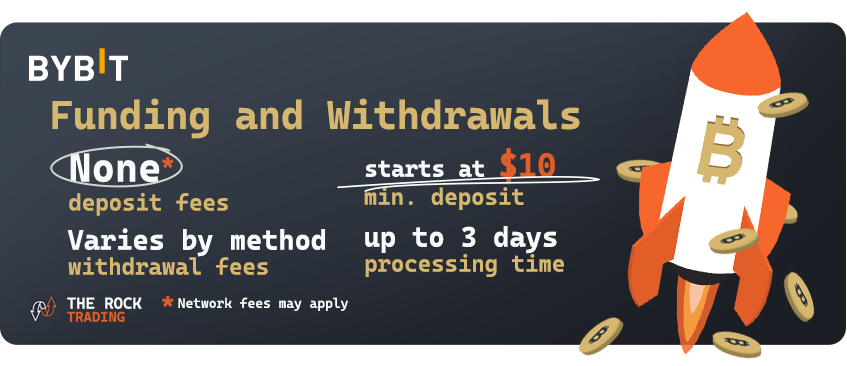
You can fund your account with crypto transfers, bank transfers, card payments, or peer-to-peer (P2P) transactions. Availability depends on your region and the entity you’re registered under.
Deposit Methods and Processing Times
The table below outlines the main funding methods, typical processing times, and whether Bybit charges a direct fee.| Deposit Method | Assets Supported | Processing Time | Bybit Fee | Notes |
|---|
| On-Chain Crypto | BTC, ETH, USDT and other supported tokens | Typically 5–30 minutes (network dependent) | 0% | Standard blockchain confirmations required |
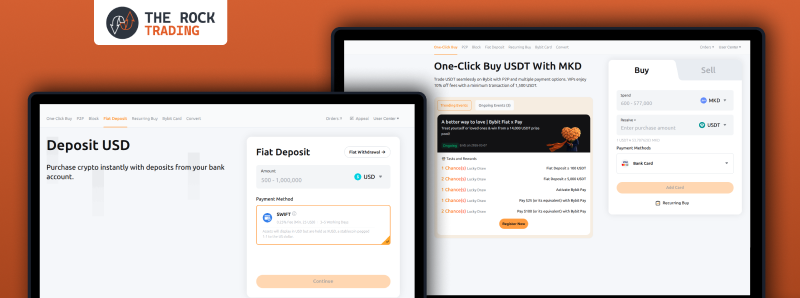
| Bank Transfer (SEPA/SWIFT etc.) | Selected fiat currencies | 1–3 business days | 0%–2% (varies by provider) | Processed via third-party payment partners |
| Card / One-Click Buy | Multiple fiat currencies to crypto | Instant (subject to approval) | ~1%–3% (provider dependent) | Includes card processing fees |
| P2P Trading | USDT, BTC, ETH and others | 15–60 minutes | 0% (platform side) | Price set by individual merchants |
Bybit does not charge fees for standard crypto deposits. However, fiat deposits and card purchases are handled by third-party providers, and those providers set their own fees. These costs are shown before you confirm the transaction.
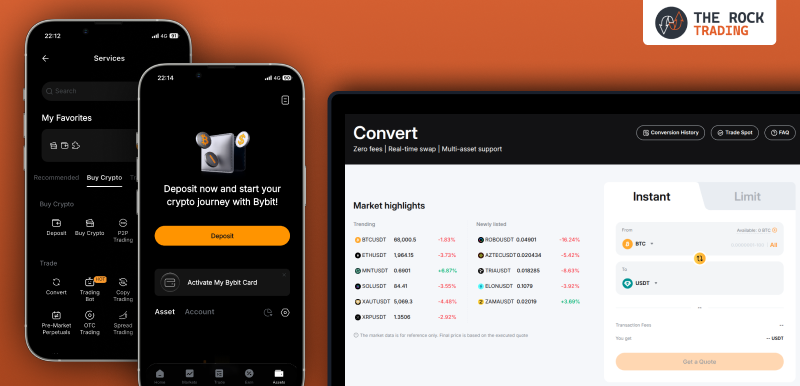
Crypto Withdrawals
Withdrawals are processed from the Funding Account and require two-factor authentication. Processing time depends on the asset and network conditions.
Withdrawal Methods and Limits
The table below summarises Bybit’s different withdrawal methods, fees, and processing times.| Withdrawal Method | Typical Fee | Processing Time | Notes |
|---|
| On-Chain Crypto | Fixed per asset (varies by network) | Usually within minutes, network dependent | Fee adjusts based on blockchain used |
| Fiat Bank Transfer | Varies by currency and provider | 1–3 business days | Third-party banking partners used |
| Internal Transfer | Free | Instant | Between Bybit users |
| Bybit Card (ATM) | Around 2% | Instant (subject to ATM network) | Conversion fees may apply |
Crypto withdrawal fees depend on the blockchain selected. For example, USDT withdrawals cost less on TRC-20 than on ERC-20. Network congestion can affect both cost and confirmation time.
For security, changes to key account settings such as password or 2FA typically trigger a temporary withdrawal lock.
Withdrawal limits increase with verification level. Entry-level verified accounts have daily limits, and higher tiers allow larger withdrawals.
Bybit’s funding scores 7/10 for its efficient ecosystem, Bybit Card, and the integration of local fiat rails. The 1M USDT daily limit for basic KYC users is generous compared to peers. However, the reliance on third-party providers for One-Click Buy can lead to high hidden fees.
Risk and Trading Rules
Bybit’s risk system is built around margin requirements, position limits, and automated liquidation rules. If you use the Unified Trading Account (UTA), margin can be shared across products, meaning unrealised profit on one position can offset margin requirements on another. This improves capital efficiency, but it also means risk is interconnected across positions.
For derivatives, Bybit applies a Risk Limit system. As your position size increases, your required initial and maintenance margin increases as well. Larger positions therefore reduce your maximum available leverage. This scaling is designed to limit excessive exposure on very large trades.
Liquidations are triggered using a Mark Price, not the last traded price. The Mark Price is based on an external index and is intended to reduce the impact of short-term price spikes on forced liquidations.
Allowed Crypto Trading Strategies
Bybit does not prohibit common crypto trading strategies such as scalping, intraday trading, or hedging, provided activity complies with its terms of service.
You can:
- Place high-frequency manual trades
- Use API connections for automated systems
- Run native Grid or DCA bots
- Use webhook integrations (for example, TradingView alerts)
- Enable Hedge Mode on supported perpetual contracts to hold long and short positions simultaneously
Copy trading is also available. You can follow other traders and allocate capital to mirror their trades, with risk controls such as position limits and stop mechanisms built into the system. Availability depends on the region.
Stop-Out and Liquidation Process
Bybit uses a tiered liquidation process on derivatives. When your Maintenance Margin Rate (MMR) reaches 100%, the system begins by cancelling open orders to free up margin. If the margin level continues to deteriorate, positions are partially reduced before full liquidation occurs.
If partial liquidation does not restore required margin levels, the position is closed at the bankruptcy price. In extreme cases, auto-deleveraging (ADL) can apply, where opposing traders’ positions are reduced based on priority ranking.
An insurance fund is used to absorb certain losses when positions cannot be closed above bankruptcy price, though this does not eliminate market risk.
Leverage and Margin Availability
Leverage limits depend on the product, asset, position size, and regulatory entity.
On global offshore entities, maximum leverage on major perpetual contracts such as BTC and ETH can reach up to 100x for smaller position sizes. As size increases, available leverage decreases automatically under the risk limit system.
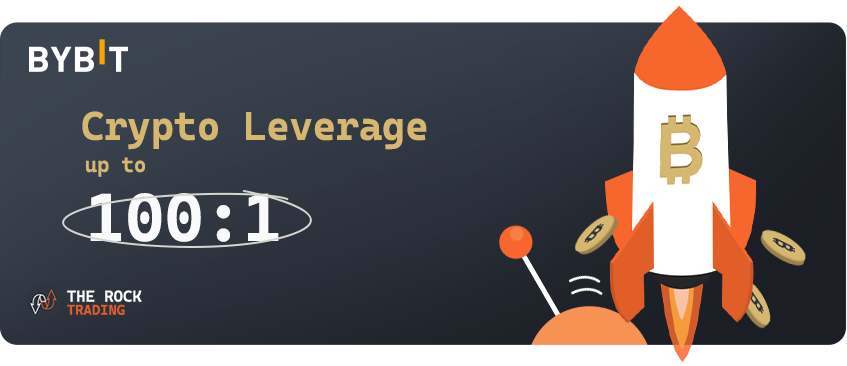
For mid-cap and smaller altcoins, leverage caps are generally lower.
In the European Economic Area, leverage is significantly more restricted under MiCA-aligned rules and may be limited to low single digits depending on the product and classification.
For spot margin trading, leverage can reach up to 10x on selected assets. You can choose between:
- Isolated Margin – risk limited to a single position
- Cross Margin – shared balance across positions
- Portfolio Margin (UTA) – risk-based calculation across hedged positions
Leverage availability is subject to change and depends on your verification level and jurisdiction.
Geographic Restrictions
Bybit restricts access in certain jurisdictions due to regulatory requirements. The platform is not available to users in the United States. Other restricted or limited regions can include mainland China and sanctioned jurisdictions, with product-level restrictions applying in parts of Europe and the United Kingdom.
Access to derivatives, leverage levels, and certain programs depends on the legal entity onboarding your account.
Bybit’s sophisticated risk infrastructure, the soft landing approach of its liquidation system, and derivative-focused ecosystem may suit most individual traders. While the strict 100% Maintenance Margin requirement and the 24-hour security lock on withdrawals are stiff, these rules can be vital safeguards for overall stability, and that’s why they get an 8/10 score.
ByBit Final Score
Bybit receives an overall score of 77/100 in our review. The platform performs strongly in derivatives markets, platform functionality, and overall asset coverage. Maker–taker fees are in line with other large offshore exchanges, and liquidity on major perpetual contracts is generally consistent.
At the same time, regulatory coverage depends on the entity you register under, and the exchange does not operate under a traditional investor compensation scheme. Past compliance issues and its offshore operating history are part of the overall risk profile.
If you primarily trade leveraged crypto derivatives and understand how margin, funding, and liquidation mechanics work, the platform structure aligns with that style of trading. If you prefer fully regulated, lower-leverage environments, regional restrictions and entity differences matter more.
How We Scored Bybit
The table below shows our six category scores for crypto exchanges. Each category is weighted equally. We average the six scores, then multiply by 10 to convert to a score out of 100 (rounded).| Category | Score (Out of 10) | Why It Scored This Way |
|---|
| Fees | 8 | Tiered maker–taker structure with lower costs at higher volumes; standard retail spot fees are in line with major exchanges. |
| Markets | 9 | Large range of spot assets and active perpetual futures markets, with strongest liquidity in major pairs. |
| Platforms | 9 | Full-featured web platform, TradingView integration, API access, and derivatives tools. |
| Safety | 7 | Multi-entity regulatory structure and published Proof of Reserves, but no deposit guarantee scheme and past compliance issues noted. |
| Funding | 7 | Multiple crypto and fiat on-ramp options; third-party processing fees vary by region. |
| Rules | 8 | Structured risk limit system, tiered liquidation model, and adjustable leverage depending on asset and jurisdiction. |
Overall score maths: (8+8+8+7+7+8) ÷ 6 = 7.7 = 7.7/100 = 77/100 (rounded)