Basic Concepts of Cryptocurrency
Cryptocurrency is a digital currency that exists online, with no physical money involved. Unlike traditional payment methods and currencies controlled by central banks, such as the US dollar or the Euro, this new virtual currency operates through a decentralized system.
No central authority or official financial institution controls the cryptocurrency industry. Hooked together via blockchain technology, secured cryptographic techniques, and verified by peer-to-peer cryptocurrency transactions, the whole system is tough to breach or manipulate.
Traditional government institutions issue physical currencies, and you are trusting that the central bank will guarantee the legal value of your money. On the other hand, cryptocurrencies work through a decentralized structure, with secure transactions made possible through the blockchain, which is a public ledger that records transactions across thousands of computers simultaneously.
This network, with its vast shared computing power and consensus mechanism, will handle the backend for cryptocurrency payments, removing the need for a trusted third party, such as a bank, to verify transactions.
The Bitcoin System – The First Cryptocurrency
Introduced in 2009, the first cryptocurrency was Bitcoin, launched by an anonymous person (or group) using the name Satoshi Nakamoto. The arrival of Bitcoin was revolutionary, becoming the foundation of the decentralized finance that will soon rise, creating a digital currency that can’t be duplicated, faked, or controlled by a central authority. Satoshi was the first one to finally solve the “double-spending” problem that plagued earlier attempts to develop a new virtual currency.
 Blockchain technology was the answer to this problem, a distributed ledger containing each and every cryptocurrency transaction, spread across peer-connected devices worldwide. This global network uses cryptographic techniques to verify cryptocurrency transactions, a process known as mining.
Utilizing the massive collective computing power, miners solve complex mathematical problems, verify transactions within the cryptocurrency network, and add new entries to the blockchain.
All of this is achieved within the Bitcoin system without a central authority like central banks, with the distributed ledger system ensuring the integrity of the entire network.
One of the main philosophies of Bitcoin as a digital currency is transparency, where anyone can view the blockchain ledger, while remaining private, as no names are ever included in all crypto transactions.
Unlike fiat currencies that can be printed at will by central banks, bitcoin has a fixed supply of 21 million coins, with the implied scarcity making bitcoin a digital asset resistant to inflation. To this day, Bitcoin is still the most popular cryptocurrency and the crypto with the highest market cap.
Virtual Currency vs. Legal Tender
Bitcoin is a virtual currency that exists digitally; you cannot physically own it, and should the internet somehow be shut down in a global catastrophe, it will be gone, unlike physical money. Legal tender is the official currency that governments back with their own cash and gold in the central bank system, and the actual money that creditors are required to accept, such as fiat currencies like the US Dollar and the Euro.
While many businesses are now accepting bitcoin and other cryptocurrencies as payment, these digital assets are not considered legal tender. The key difference here is that even if a business or a person is willing to transact using cryptocurrencies, they are not legally obliged to accept these digital assets as payment, the way traditional money is.
A toy store can take any form of payment they want, whether it be bitcoin, Pokemon cards, or outright reject them. They are free to do so, as none of these are legal tender. But if a customer wants to pay with physical money like the greenback, they are obligated to accept it, because it is the official legal tender.
One that has recently made headlines around the world is when El Salvador officially adopted Bitcoin as part of the country’s official financial system. Most countries, however, still treat cryptocurrencies as financial assets, which can potentially trigger capital gains taxes, the same way stocks or real estate holdings will. While some countries, such as China, are declaring all crypto transactions illegal.
How Cryptocurrency Works (Technical Concepts)
The decentralized nature of cryptocurrencies has revolutionized the financial industry. Traditional payment systems rely on financial institutions like banks to verify and authenticate transactions, whereas cryptocurrencies eliminate the need for third parties through their decentralized structure and cryptographic techniques.
Instead of a central authority keeping track of every transaction happening, cryptocurrency introduces a decentralized finance network where thousands of computers connected globally share the same transaction ledger and maintain the network’s integrity. Encryption algorithms make it next to impossible to hack or cheat the system by double-spending a digital currency within a network.

Blockchain Technology and The Ledger
To operate independently of banks and other financial institutions, cryptocurrencies use blockchain technology, a distributed ledger system in which thousands of copies exist simultaneously across the peer-to-peer network worldwide, rather than relying on a centralized institution. The blockchain acts as an online and public record book, allowing every connected device to verify transactions and, at the same time, ensuring the security and integrity of the entire system.
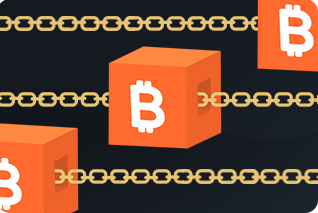 When dealing with traditional financial assets, the involved parties in the transactions need a trusted third party, like PayPal or a bank, to make a valid and legal transaction. But with virtual currencies, transactions are grouped together into blocks of data, where each block of data contains a batch of recorded transactions.
With a unique cryptographic hash included in each block, all transactions contained in a block are timestamped and are chained together, making it resistant to hacking and manipulation, as hackers will have to change all blocks in the chain, making it virtually impossible to change all the peer-connected blocks.
The proof-of-work system introduced by Bitcoin relies on a consensus mechanism in which all connected systems must agree on which transactions are valid, negating the need for a trusted third party. In this system, crypto miners race to solve a complex mathematical problem, and the first miner to solve it is rewarded with cryptocurrency, as they get to add the next block and record transactions.
The peer-distributed ledger will then be updated across all connected nodes, ensuring that all participating nodes’ copies are synchronized.
Cryptocurrency Transactions and Payments
 When sending cryptocurrencies to parties that accept Bitcoin, a secure transaction will be broadcast to the network with a signed proof using a private key. The entire cryptocurrency network will simultaneously validate the transaction before adding it to the blockchain ledger.
These crypto transactions will first go into a holding area called a mempool while waiting for confirmation. This network validation system ensures that all crypto transactions that happen are legitimate, making sure the coin has not been spent elsewhere. A transaction will be immutable, cannot be reversed once confirmed, unlike credit card transactions with a bank.
This consensus mechanism eliminates the need for a third-party observer. This revolutionary payment system has significantly lower fees, faster cross-border transactions, all without the need for traditional financial institutions. Cryptocurrency transactions cut out banks entirely, as transactions made here do not require permissions from third-party entities.
Wallets and Private Keys
Before a trader or investor can interact with blockchain networks, they will need a cryptocurrency wallet to store private keys. The wallet will act as the public address, like an email address people use to buy or sell cryptocurrencies. However, losing the unique key will make your crypto assets gone forever, since cryptocurrencies don’t have a “forgot password” option.
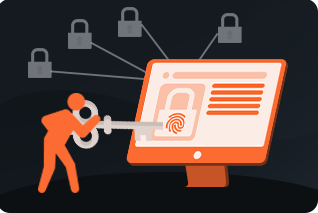 If you want to trade cryptocurrencies, your crypto wallet uses your own digital key to create a virtual signature that authorizes the trade. These private keys are complex and random strings of characters that prove you own the specific cryptocurrency asset, and with the built-in encryption algorithms, it is computationally impossible to hack or reverse-engineer the private key from the publicly accessible information in the peer network.
To own cryptocurrency, an investor has two options: either store it inside a crypto exchange or inside the investor’s own personal wallet. Putting crypto assets inside a personal wallet gives you complete ownership and control, where nothing can freeze your account or stop you from accessing your cryptocurrency holdings.
These crypto wallets can be hot wallets, meaning they are connected to the internet, making it convenient to buy and sell cryptocurrency. Cold wallets, on the other hand, or offline storage methods, are completely disconnected from the internet and ideal for long-term storage of crypto holdings.
The other alternative is storing cryptocurrency inside a crypto exchange. Buying cryptocurrency through an exchange is convenient for quick trading, but it is riskier. There is a saying in the cryptocurrency industry, “not your keys, not your coin.” If you don’t store your virtual currencies inside your personal wallet, you could lose access to your digital assets inside an exchange if they get hacked, go bankrupt, or worse, steal your cryptocurrencies.
The Cryptocurrency Market and Industry
From a tech experiment by activist geeks, cryptocurrencies have now exploded into a multi-trillion-dollar crypto industry. Bitcoin was the first cryptocurrency, and since then, the crypto ecosystem has grown to include thousands of cryptocurrencies, and many cryptocurrency exchanges continue to add to the hundreds already operating. Millions of traders worldwide trade all the popular cryptocurrencies, with a total crypto market cap at one point reaching as high as 4 trillion dollars.

Market Cap and Market Data
Cryptocurrency is a digital asset that can bypass the central authority, ushering in the era of decentralized finance. Cryptocurrency works as an alternative to traditional payment systems, and in order to succeed in crypto investing, you need to understand the market data that comes with these financial assets. These include metrics like market cap, which allows traders to gauge the size and stability. To get a cryptocurrency’s market capitalization, simply take the price of a particular coin and multiply it by the total coins in circulation.
 Commonly used with traditional stocks, it is essential when planning to buy cryptocurrency. A coin priced at $0.50 may appear cheap, but if there are billions of them in circulation, the market cap can be potentially huge. When managing cryptocurrency investments, this financial data allows investors to compare coins and their relative value, regardless of their actual market price.
Established cryptocurrencies like Bitcoin and Ethereum typically have higher market caps, greater liquidity, and are relatively stable compared to other cryptocurrencies with smaller market caps. Popular cryptocurrencies usually have more liquidity, but coins with a lower market cap may offer greater upside but also carry greater risk.
Aside from market cap, cryptocurrency investors also look at several key data points when trading cryptocurrencies. Trading volume is equally important when looking for new cryptocurrencies to trade, as it is an indicator of financial instrument health, with higher volume indicating tighter spreads. Price charts that come with technical indicators are also a crucial part of any investing strategy in today’s trading environment.
Reputable cryptocurrency exchanges typically offer most of the vital market data needed in order for a trader to develop a sound trading strategy. Binance, Coinbase, and Kraken are some of the most popular crypto exchanges, offering real-time market data for thousands of cryptocurrencies.
Cryptocurrency aggregators like CoinGecko and CoinMarketCap, on the other hand, collect data from most exchanges and allow traders to have a handle on the current crypto market situation. Not only that, but it also helps traders identify crypto assets that are trending, best performing, or with the most volume, allowing traders to make better trading decisions.
Central Bank Digital Currency (CBDC)
 With cryptocurrency growing rapidly and massively, governments around the world have become increasingly nervous. The rise of decentralized finance has also led to fears that central banks will lose control over monetary policy.
In their attempts to control the situation, governments have started to introduce their own versions of virtual currencies, central bank digital currencies, or CBDCs. Basically, the digital version of a country’s fiat currency, like a digital dollar or euro, is issued and controlled by the central bank. While these CBDS exist digitally like cryptocurrencies, they are fundamentally different from decentralized crypto assets.
Designed to slot seamlessly into the traditional financial systems, CBDCs may allow for faster and cheaper payment systems, without the anonymity of cryptocurrencies, and still be directly controlled by the government. From the user’s perspective, CBDCs would function like cryptos for online payments. A personal digital wallet on a mobile device can make instant transfers without the need for physical currency.
For the crypto industry, this is designed to introduce legitimacy to official digital assets while offering competition to cryptocurrencies. If CBDCs launched by governments succeed and gain traction, the public may prefer these official virtual currencies over decentralized assets, especially for those seeking the convenience of digital currencies without the risks of cryptocurrencies.
If done correctly, this can be a game-changer for financial institutions, optimizing the transaction process while reducing costs. But proponents of cryptocurrencies see this as the opposite of why the crypto industry flourished in the first place. CBDCs may offer efficiency, but those benefits are offset by the loss of anonymity and independence from a central governing body.
Investing and Trading Concepts
Crypto investing and trading are two distinct concepts, and this is where The Rock Trading comes into play, helping traders understand how to participate in the crypto market. Buying cryptocurrency for long-term investment or trading it actively are both valid approaches, but require completely different strategies, market psychology, and different crypto trading platforms.
Cryptocurrencies have exploded over the past few years and have evolved to offer many potential approaches to trade and participate, and at The Rock Trading, we will have cryptocurrency explained, especially to newcomers wanting to engage with the popular cryptocurrencies. And to find the right cryptocurrency platform for your trading requirements is the first step to success.
Cryptocurrency Investments vs. Crypto Trading
Most people will freely interchange investing and trading, but really, they are two massively different concepts. Cryptocurrency investing is usually for traders following a long-term strategy, with the online trading community lovingly calling themselves “HODLers” who believe in the project’s long-term potential.
Investors build their portfolios through several months, or even years, riding out historically big drawdowns, believing in the cryptocurrencies’ investment value. These hodlers don’t care what happens in the charts short term, they look at the big picture, and see where the crypto industry is in 5 years.
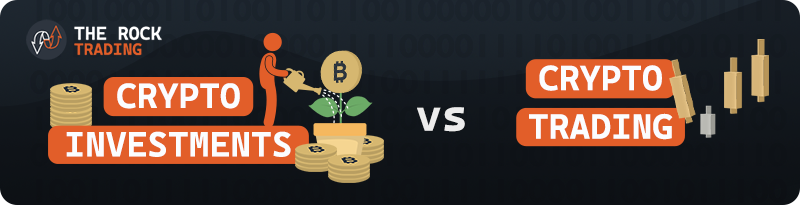
For those looking for more action and taking advantage of the volatility of cryptocurrency trading, actively buying and selling can yield significant profits. Traders usually do not focus their attention on blockchain technology or the long-term vision for cryptocurrencies.
They look instead at price charts, emerging trends, and riding the extreme volatility that comes with crypto trading. Crypto traders can profit multiple times a day by riding small price swings. But this strategy requires constant monitoring of market data, analyzing charts, and making trading decisions based on these analyses.
Tax profiles for crypto trading and investing also differ dramatically. For US traders, the Internal Revenue Service treats cryptocurrency and digital assets as property. This means that every selling transaction is potentially a taxable event, subject to capital gains rules. Taking this into consideration, long-term investors may get better tax treatment by holding cryptocurrencies for over a year. At the same time, active trading generates more short-term capital gains tax at higher rates. Net returns can be significantly affected by this tax profile difference.
Crypto Exchanges – Buying Real Assets
For those looking to really own cryptos, the first step is to find a cryptocurrency exchange. This is the platform that will allow you to buy cryptocurrency using fiat currencies like the US Dollar, Euro or the Yen. Investors can then either store bitcoin and other cryptocurrencies on the exchange itself or transfer them to their digital wallet.
 Using a cryptocurrency exchange lets you swap cash from your bank accounts for virtual currencies. Exchanges allow the trader to gain access to the broader cryptocurrency ecosystem, opportunities to stake their coins to earn competitive yields, or participate in numerous decentralized finance activities.
While many traders will prefer to transfer their coins to their own digital wallets for peace of mind and security, crypto traders usually store their cryptocurrency assets inside exchanges for convenience, especially when they are active in buying and selling cryptos.
While cryptocurrency exchanges may charge fees for their services, like commission fees, network fees when transferring digital assets to your wallet, and other charges for the trading convenience they offer, you are still ultimately in charge of your virtual currencies’ security. The tradeoff for trading and DeFi convenience is that cryptocurrency exchanges can be hacked, just like what happened to the Mt. Gox exchange. Still, most exchanges are now safe and secure. You just need to be mindful of your personal account’s security.
And to help traders decide on which crypto exchange to go with, TheRockTrading.com provides detailed reviews for top-tier exchanges like Binance for its impressive roster of popular cryptocurrencies, altcoins, Coinbase for their easy-to-use user interface, and many more crypto-related platforms. Visit our site to help you differentiate between the exchanges, and help you decide where to buy cryptocurrency, and find platforms that are best suited for your own investment or trading requirements.
Some crypto participants care only about the actual trading and profit potential that comes with it, without dealing with wallets, personal keys, or blockchain technology developments. For them, financial products like contracts for difference (CFDs) are perfect. Crypto CFDs allow them to speculate on the price of cryptocurrencies without ever buying the virtual currency. Traders are essentially making a bet with the CFD broker, whether the crypto price will go up or down, using traditional fiat currency to settle trades.
This trading setup is perfect for pure traders. Without physically owning coins, traders can go long, betting that prices will rise, or go short when they think crypto prices will fall. CFD traders don’t need to deal with digital wallets, because they will not take delivery of cryptocurrencies when they “buy” on CFD brokers. For traders already experienced with stock or forex trading, this is often their preferred point of entry into the cryptocurrency market.
Other key benefits of using CFD brokers include the availability of leverage. This allows traders to be able to trade larger positions than their capital would allow. An account with 1:10 leverage will be abe to trade up to $10,000 worth of cryptocurrencies, even with only an account of $1,000. This gives the trader a 10x profit potential but also dramatically increases the potential for loss. Using CFD brokers also provides for a streamlined trading experience, using traditional currencies linked with your bank account, and the regulatory protection that comes with them.
If you want to speculate on crypto prices and test your trading skills, check out TheRockTrading.com reviews of the leading CFD brokers that have cryptocurrency trading, breaking down spread differences, available leverages, and product features. You can look at Eightcap, popular for its competitive instrument spreads, Pepperstone, known in turn for fast trading executions, and many other reviews.
Prop Trading – Accessing Funded Capital
 A third option has recently burst onto the cryptocurrency scene: prop trading. For the skilled trader with a proven strategy but lacking capital, prop trading offers a unique opportunity.
If you can pass their evaluation challenge, proving to them you can trade profitably while staying disciplined in managing risks, you can get access to a funded account. With this account, you can trade with the prop firm’s capital without risking your entire bank account, and get to keep a large percentage of the profits, often around 80%.
Prop trading fixes one of cryptocurrency trading’s biggest barriers to entry, the lack of trading funds. Skilled and qualified traders for a funded account can scale their trading accounts potentially up to $50,000, $100,000, and with some prop firms offering in the millions, with only a minimal fee to take the “challenge” as the only risk.
The requirements will vary across prop firms, but the common theme is a focus on risk management, not just profitability. They only want to fund traders that can consistently hit profit targets, usually around 8%, while keeping drawdowns low, usually at around 5% daily, and at around 10% max.
If you are confident in your trading skills and risk management, and want to scale up your trading size, TheRockTrading.com reviews various prop trading firms that offer cryptocurrency trading. There, you can compare challenge structures, profit splits, trading rules, available crypto instruments, and more. Exploring prop firms could be the next breakthrough your trading career needs, and among the top prop firms in the crypto space, check out the reviews of Blueberry Funded and BrightFunded.
Is Cryptocurrency Safe? Risks and Regulation
From a technological point of view, the blockchain technology behind cryptocurrency is incredibly secure. The decentralized nature of these virtual currencies makes hacking the network virtually impossible. However, the human or the social aspect of this industry is where things get risky. There have been many publicized hacking issues in the past, particularly the Mt. Gox cryptocurrency exchange hacking, and more recently, the FTX scandal.
Because transactions on the blockchain are irreversible, if you send cryptocurrencies to the wrong address, there is no way to get them back, as there is no government agency or central authority to reverse the transaction. And with bad actors using cryptocurrencies to launder money and criminals transacting on the dark web, governing bodies worldwide are now starting to crack down on illegal activities, as the blockchain ironically is a bad place to hide them.
After all, the distributed ledger is publicly viewable. And now, government agencies like the Financial Action Task Force (FATF) are pushing hard for more regulations to ensure the crypto industry remains safe for all participants.
Regulation and The SEC
Gone are the days when the crypto space was the Wild West of finance. Governments are now stepping up efforts to bring order to the cryptocurrency market, with the USA’s Securities and Exchange Commission (SEC) taking an active role in ensuring fair market operations and protecting all parties involved.
There has been an active debate over whether certain coins should be considered securities, with the US SEC arguing that many ICOs, Initial Coin Offerings, are acting very similarly to unregistered stock offerings and should fall under its regulatory authority, putting thousands of other cryptocurrencies in legal limbo.
Bitcoin appears to be safe, with both the Securities and Exchange Commission and CFTC stating that BTC is a commodity, and not a security. Ethereum remains in a gray area, but recent official statements suggest it will be classified as a commodity as well.
At the same time, the Internal Revenue Service (IRS) has indicated that traders and investors in the USA cannot hide their cryptocurrency gains from the IRS, effectively treating crypto as property for tax purposes. Every transaction involving crypto, whether buying or selling in an exchange, or even using it to buy a service or product like coffee, is a taxable event.
The IRS now requires participants to report these transactions, and failure to do so can result in heavy fines. While this may add short-term hassle, it can also be seen as a sign that the industry is now maturing and integrating into the global economy.
Volatility and Financial Risks
The cryptocurrency market is not for the faint of heart, with the industry known for its volatility compared to traditional financial instruments like the stock market. Double-digit moves in either up or down direction are relatively common in the crypto market, moves that will cause massive panic in the stock market.
When valuing stocks, one can look at the company’s earnings performance, dividend yield, and other details in the financial statement to have a clue how much a company is worth. But with cryptocurrencies like Bitcoin, there is no definitive way to measure intrinsic value, other than supply and demand, and market sentiment. This makes price discovery erratic, leading to big volatility moves and bubble pops over the years.
Investing in whatever financial asset class always carries risks one way or another, but this risk is multiplied when dealing with cryptocurrencies. The saying that one should never invest money they cannot afford to lose applies to both beginners and experienced alike.
The potential for high returns is definitely there, as this is what draws the people in, but the risk of loss is just as substantial. The market may be relatively young, but to answer the question of whether cryptocurrency is safe ultimately boils down to one’s personal risk tolerance and market understanding.