How to Open a Crypto Account – Should You Use an Exchange, Broker, or Prop Firm?
There are specific routes you can take to trade cryptocurrencies, whether buying and holding your coins for years, trading to take advantage of price swings, or looking to make more funds available for trading. There is no one-size-fits-all, and this section will break down the right path for you.
The Crypto Exchange Account: To Buy Sell and Store
 For most people who are looking to trade or invest in coins like Bitcoin, Ethereum, and other popular digital assets, creating an account with a standard crypto exchange is a good start. Aside from investing in crypto, using this investment platform will offer broad exposure to other cryptocurrency-related products. Using fiat currencies like the USD, investors can also participate in decentralized finance market activities, like staking coins.
But before you can buy coins and do other activities inside the exchange, these platforms need to verify your identity using the KYC, or Know Your Customer. This is done to help protect you and their other customers’ investments, reducing the risks involved. And once the personal cryptocurrency profile is approved, you will be assigned a crypto wallet, where you can store bitcoin and other digital assets. In the cryptocurrency exchanges, investors can buy, sell, or even transfer crypto to other investors, making this kind of setup the best route for traders who want to have full control of their cryptocurrencies.
The CFD Broker Account: Active Cryptocurrency Trading
Investors coming from other markets, such as the stock market, who want to take advantage of the highly volatile nature of cryptocurrencies will want to open accounts with CFD brokerage services that offer crypto trading. Without ever actually owning cryptocurrencies, investors with high risk tolerance can get access to more trading opportunities and chances to grow the value of their money.
 This type of cryptocurrency trading is the preferred way for investors who want to gain exposure to this market without bothering with wallets, private keys, and other hurdles usually associated with crypto. Simply open a crypto trading account with a CFD broker, deposit some money, and then you can trade right away. These brokers also typically offer leverage, allowing traders to control a bigger trading value with less money upfront. While this type of investing involves risks higher than normal, if done correctly, it can significantly increase the trader’s investment portfolio.
While the risks of losing money are greater, trading cryptocurrency with CFD brokers offers the advantage of speed and flexibility. And if investors know what they are doing, they can potentially ride bitcoin’s price moves, whether the market is going up or down, as CFD traders can short cryptocurrencies when prices are falling. Since they do not actually own the digital currencies, they only use short-term strategies to trade the crypto price moves.
The Prop Firm Account: Accessing Funded Capital
For cryptocurrency investors who have the skill but don’t have enough investment money to make an impact, prop firms offer a unique solution. For a relatively small challenge fee, you can try to prove you have the skills and discipline. Prop trading firms create a platform for traders to gain access to significantly bigger trading funds, without the risk of losing their entire life savings. Pass the challenge, and you can trade the firm’s capital, allowing for bigger profit potential, with zero risks to your money.
 Proprietary trading has become popular in the cryptocurrency market in recent times, after the initial surge with forex traders. Prop firms have offered a solution to a problem many skilled traders have faced: the lack of trading funds. If you can show prop firms that you can profitably trade cryptocurrencies and that you can manage risks effectively, they can provide you with the platform to scale your profit potential higher with a funded account. Using the firm’s funds, all profits generated from your crypto transactions, you get to keep a big chunk of the profits, usually around 80%, as the firm’s way of paying you management fees.
While this attracts many cryptocurrency traders hoping to make it big, the challenges require traders to overcome strict rules. Traders are typically required to hit profit targets, avoid hitting daily and total drawdown limits, and follow a bunch of other trading rules. Miss a profit target, breach a limit, or break a single rule, and you are out. No ifs or buts. And being largely unregulated, you need to do due diligence before joining one, and trust the prop firm to honor your profit agreements. But if all goes according to plan, this is a great platform for cryptocurrency traders to quickly grow their portfolios with minimal risk.
What is the best crypto account to open?
Each has its own pros and cons, different goals, with no single best platform for trading cryptocurrencies. Those with long investment horizons in digital assets like Bitcoin and other cryptocurrency-related products, crypto exchanges make the most sense. CFD brokers are best for traders seeking leveraged exposure to cryptocurrencies, also allowing them to trade the market’s volatility without actually owning them. Those lacking the capital but having the skills and discipline should opt for prop firms. The final decision depends on your risk tolerance, investment objectives, and your available capital.
How to Open a Crypto Trading Account
Buying Bitcoin and other cryptos isn’t as hard as it looks, but depending on the platform you want to invest in cryptocurrencies, the process typically follows a similar path, regardless of the platform.
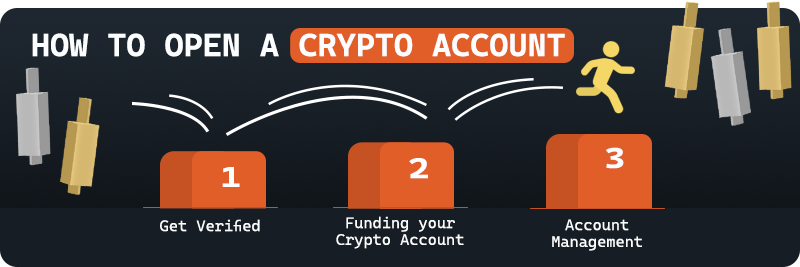
- Step 1: Get Verified / Sign Up
- Step 2: Funding Your Crypto Account
- Step 3: Account Management and Security
Step 1: The Verification Process and Regulation
Crypto platforms need to verify your identity, with verification processes standardized among exchanges, CFD brokers, and prop firms, with exchanges usually the strictest. This is done to comply with global AMLA or anti-money laundering laws before you can start trading, and it is a must before you can get your profit share from prop firms.
Identity Checks and Brokerage Services
Reputable crypto exchanges like Binance and Coinbase will require investors to provide identification details. This typically requires you to provide your full legal name, residential address, and official government-issued IDs, with some platforms even requesting secondary forms of identification.
 Traders can now easily complete this process through their app or website before setting up their wallets and starting to buy Bitcoin. The cryptocurrency market has matured immensely since its early days, with crypto exchanges now offering streamlined processes to make it easier for investors. Once you upload copies of the required documents and photos, or even proof of life verification, the approval process can take as early as minutes, or after a day or two. CFD brokerage services usually follow the same regulatory protection efforts and processes, as they also deal with money transfers and the same financial regulations.
For prop firms, the process is more lenient, since traders do not deposit funds with the broker or crypto platform, as they only pay a fee to participate in the trading challenge. Basic information like name and email address is usually enough to start the evaluation process, with the real verification process coming in later when you pass the challenge. And before you can get the funded prop account, you need to comply with the same KYC requirements that crypto exchanges and brokers require, since they’ll be giving you your share of the profits from your trading activities.
Regulation and Risk
 Compared to other forms of investment, the crypto industry is not protected in the same way as established markets using traditional currencies. When buying stocks or other security products through registered brokers in the USA, you are protected by agencies like the Securities Investor Protection Corporation (SIPC) and by the Commodity Futures Trading Commission (CFTC) if you are trading futures contracts, offering investors a layer of safety and recovering some, if not all, of their investments if the broker goes under.
With cryptocurrencies, investors do not have the same level of regulatory protection and support from government agencies. If a crypto exchange goes bankrupt or gets hacked, you might lose all the cryptos you store with them if you don’t use a hardware wallet. Investors do not have government protection or insurance coverage to back up their digital assets in case something goes wrong.
Here’s a quick breakdown of the regulatory landscape for each crypto investment approach:
- Crypto exchange regulations are becoming clearer each year, but they still vary widely by country. While most operate with minimal government supervision, some cryptocurrency exchanges are now being regulated in more countries and follow strict rules. Still, the level of protection remains a far cry from that of stocks or investments using traditional money.
- CFD brokers are typically safer, as long as investors stick with Tier-1 regulated entities like ASIC, MSA, or CySEC. The regulators have strong enforcement efforts, requiring brokers to keep client funds segregated, and have detailed steps to support investors if something bad happens.
- Prop trading firms are essentially unregulated in most countries, since they do not hold client investment funds. Traders are only paying for the challenges needed to pass and get a funded trading account. The risk here is whether the prop firm will honor the profit-sharing agreement, since no regulatory body ensures it keeps its word.
Step 2: Funding Your Account
After account verification, the next step is to fund your crypto investing activities using fiat currencies. There are several ways for you to get money into your crypto account, with differences depending on whether you are using an exchange, broker, or a prop firm. Exchanges and CFD brokers take actual client money, while prop firms only take fees from aspiring traders seeking funding.
Connecting a Bank Account or Payment Method
 Traders using exchanges or CFD brokers usually fund their crypto investing by transferring money from traditional bank accounts into their crypto wallets or broker accounts. This process has been streamlined and made easy, now even done through the platform’s mobile apps, aside from the usual website, for connecting bank accounts to your chosen crypto platform.
After connecting your bank, you can start transferring fiat currencies like USD, EUR, and GBP to your cryptocurrency account. In terms of transaction charges, bank transfers are usually the cheapest option, though this can take as long as a few business days to process. If speed is more important, credit card payments are also typically accepted. This offers almost instant funding, but comes with higher costs, charging between 3-4% of the deposit amount.
Most exchanges and brokers also support online payment portals like PayPal, Wise, and Rise, offering flexibility and more options for entering the cryptocurrency market. However, most of these crypto platforms are strict about account settlement, as they will not accept non-matching names and third-party deposits, among other measures, to comply with anti-money laundering rules. While specifics will vary per company, most will allow you to fund using traditional currencies, and then buy bitcoin and other cryptocurrencies.
Initial Investment vs. Buying a Challenge
 Proprietary firms are built differently, since crypto traders pay fees only for the chance to pass a trading challenge and get a funded trading account, not by directly depositing capital with the company. With a cryptocurrency exchange or broker, if you want to buy $5,000 of Bitcoin, you need to deposit $5,000 equivalent of money to fund the entire investment. You can pretty much do anything you want with this money, but if you lose this money, it is gone for good.
With prop firms, you can trade $5,000 or more in cryptocurrency, paying only the challenge fee, which can be as low as $20. The key advantage of this setup is that if you pass the evaluation phase and get funded, you get access to more trading capital. Even if you blow the trading fund away, the only risk to you is the challenge fee you paid, not your entire life savings, as you are basically trading the prop firm’s money.
This is an attractive setup for most traders, especially those with the required trading skills and discipline but without the capital to make an impact. Once funded, traders can get between 70% to 90% of the profits made, with the rest going to the prop firm. The downside is that passing the challenge is hard, and since you are trading the firm’s money, you have to follow their rules. These rules are strict: one wrong move will make you fail the challenge or lose your funded trader status.
Step 3: Storage and Security
There are different ways to handle crypto storage and security, depending on which platform you are trading on. Those trading on CFD brokers or through funded trading programs aren’t holding actual cryptocurrencies, so they have no need to bother with wallets and private keys the way exchange users do.
When You Need a Crypto Wallet (Hardware vs. Hot)
 Before you can invest in the popular cryptocurrencies, you need wallets to store them. Most cryptocurrency traders start with exchanges, and the first digital assets they buy will first sit on a hot wallet, hosted by the exchange. While convenient for active traders, the exchange holds the keys to these coins, making it necessary to transfer crypto to a hardware wallet like Ledger or Trezor for complete control of your coins.
This will take your private keys offline on physical devices, ensuring that your cryptocurrency holdings are safe and in your hands, even if the exchange itself gets hacked. This way, you get to follow the golden rule of crypto ownership: not your keys, not your coins. The need for hardware wallets is especially high for those who need full control of a substantial crypto portfolio.
The downside here is that setting up offline storage is cumbersome and takes effort. You need to manually manage your private keys, store them somewhere safe, while ensuring that you will not lose them or forget them. Losing the seed phrase is equivalent to losing money forever, as without it, there is no way for you to retrieve your coins. For active traders, keeping coins in a hot wallet is likely the better option. Just be smart about it, and only trade using reputable exchanges, and be aware of the market situation.
Trading Without Wallets (CFDs and Prop Firms)
 Things are simpler if you are trading digital currencies through a CFD broker or inside a funded trader program with a prop firm. You are either just dealing with futures contracts or demo money, not actually owning the underlying cryptocurrency, doing away with the need to store and secure them, and all other risks involved.
The platform will only show you your cash or equity balance, with the trading platform itself in charge of keeping your account safe, rather than you personally managing your private keys or wallets. Of course, you still need to maintain basic account security, the same way you secure your online bank accounts, rather than the tedious effort to maintain wallet protection. While you never actually own the underlying asset, if you are an active trader wanting exposure to cryptocurrency, the ease of trading without ownership hassles is a major advantage.
Managing Risks and Investing Strategies
With your crypto account ready to use, the next step is to develop trading strategies aligned with your objectives and risk profile. The strategy you will use will determine whether you will make or lose money, since crypto rewards discipline and punishes carelessness. Regardless of holding digital assets for the long term, daytrading them, or simply trying to get funded with a prop firm, without a viable strategy, you are just gambling.
Navigating High Risk and Volatility
Crypto investing involves risks, usually more than the traditional investing markets. This market is known to be highly volatile, with prices moving up to 50% in a day, sometimes in just a matter of hours, which can be catastrophic for those who are not careful. If your risk tolerance is low, cryptocurrency trading may not be suitable for you, since there is always the chance that a coin can drop 50% in a short amount of time.
 But if you can stomach the extreme price swings, the potential rewards are high. And in order to survive, new investors in cryptocurrencies should start small to get a feel of the market, and invest only money you are prepared to lose while testing the market. Diversification across a basket of coins can also help spread out the risks, as if one collapses, your investment portfolio remains alive.
Aside from trading strategies, applying risk management techniques learned from other markets, like the stock market and commodities, also applies when trading crypto. Setting up stop-loss levels and triggers is mandatory, allowing traders to limit losses and avoid being wiped out if a big downside move occurs without an exit trigger.
Different Approaches: Investing vs. Speculating
Just like in most forms of investing, there are two types of traders: either an investor or a trader. If you view bitcoin and other cryptocurrency-related products as a legitimate asset class, you are likely on a long-term investment strategy and better off sticking with crypto exchanges. With this approach, you are prepared to ride out the volatility, looking at the big picture, just like you would do with investments in gold. This works for those who view crypto as part of a diversified portfolio across multiple asset classes.
Still, the crypto market remains inherently risky, and holding it long-term doesn’t make it safe. Another angle to take with crypto is to trade them actively, especially useful for traders who are always monitoring the market. Speculative traders can even profit by selling coins or shorting them if they feel prices are going to plunge and quickly turn around to buy them and go long if they feel prices are going to bounce. These quick and frequent trading makes trading with CFD brokers the most sense. Despite the risks of active trading, if you know what you are doing, it can be a highly rewarding strategy.
Regardless of which strategy works best with your objectives, significant risks remain when investing in cryptocurrencies, including the risk of total loss. And with a lot of regulatory uncertainties remaining up in the air, only invest in cryptos with money you are comfortable losing.
How much money do you need to open a crypto account?
The amount of money needed to open a crypto account depends on whether you use a crypto exchange, a CFD broker, or a prop trading firm, and on your country of residence. Many crypto exchanges allow accounts to be opened with no minimum deposit, though practical trading usually starts from $10 to $100. Crypto CFD brokers often set minimum deposits between $50 and $200, but sometimes there’s no minimum deposit required at all like with Pepperstone, while prop firms charge a one off challenge or monthly fees instead of requiring trading capital.
What is the safest way to buy crypto?
The safest way to buy crypto depends on whether you want to own digital assets directly or gain price exposure through regulated brokers in your region. Buying crypto through a well-known exchange and transferring coins to a personal hardware wallet reduces custody risk, but trading crypto CFDs remove wallet and private key risks by offering crypto price exposure without ownership. Safety also depends on regional regulation, platform oversight, and how you store or access your crypto holdings.
How do I start a cryptocurrency account?
To start a cryptocurrency account, you choose a crypto exchange, CFD broker, or prop firm based on whether you want to own crypto or trade price movements. The process usually involves creating an account, verifying your identity where required, and setting up basic security like two-factor authentication. Exchanges typically require full KYC before you can buy crypto, and online brokers and prop firms usually require similar checks due to financial regulations. Once approved, you can fund the account with the needed minimum deposit or begin your prop challenge.
You can also read our guide on how to trade crypto for more info in things like trading strategies and setting up your first trade.